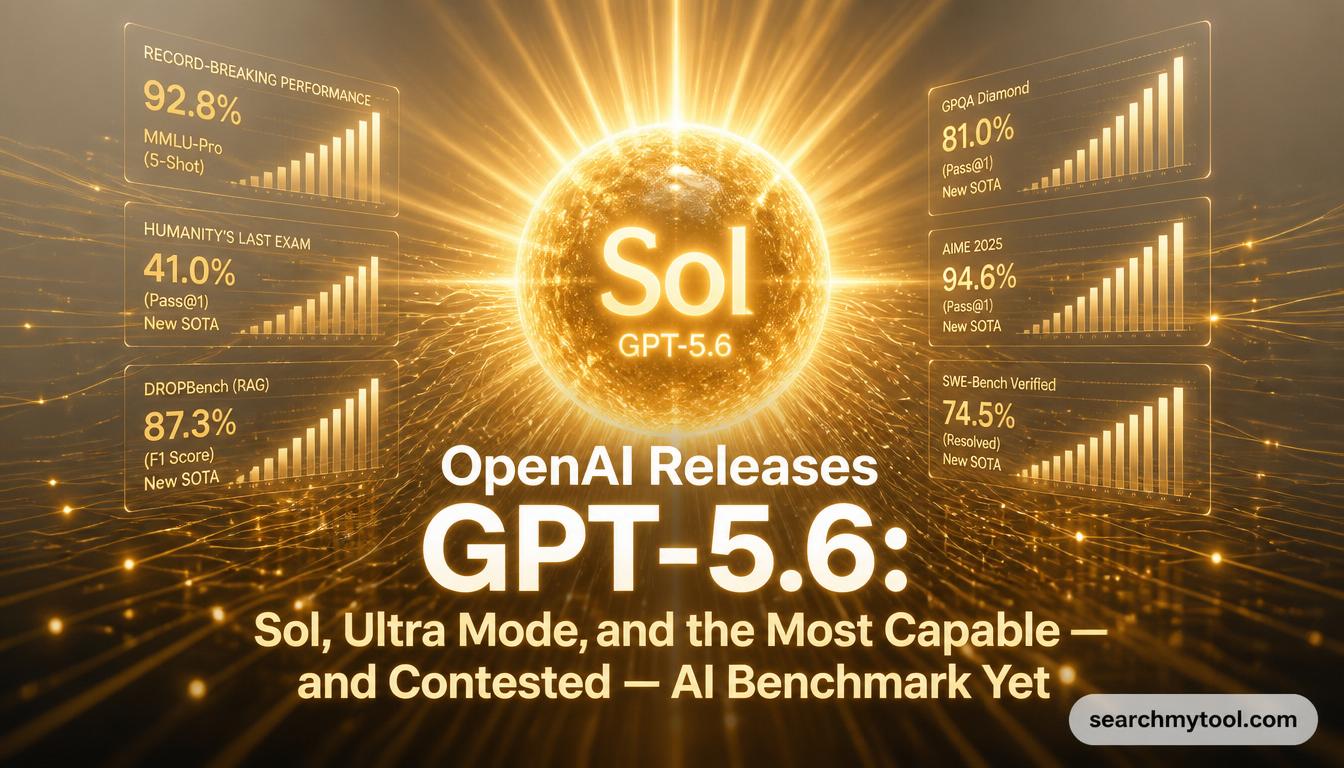
Two weeks of government review. Three new models. One Ultra mode that coordinates four AI agents in parallel. GPT-5.6 is OpenAI’s most capable and most regulated release yet — and the benchmarks tell a genuinely complicated story.
GPT-5.6 went from “the model almost nobody was allowed to touch” to “in your model picker” in exactly two weeks. OpenAI first shipped the model on June 26 under government-imposed restrictions, limited to roughly 20 pre-approved organizations while federal reviewers assessed its cybersecurity capabilities. On July 9, the gate opened. GPT-5.6 — three distinct models named Sol, Terra, and Luna — became available to all ChatGPT paying subscribers, Codex users, and API developers worldwide.
The two-week hold was the first real test of a June 2026 executive order requiring AI companies to submit powerful models for federal review up to 30 days before public release. OpenAI previewed its plans with the White House and sent technical staff to Washington. The Commerce Department’s Center for AI Standards and Innovation ran additional testing. When the July 9 release followed, the White House publicly clarified it had not granted “permission” — it had simply declined to raise concerns. The distinction matters: what happened was notification and review, not regulatory approval.
Three Models, One Generation: Sol, Terra, and Luna
GPT-5.6 is a family, not a single model — the first time OpenAI has shipped a generational release as three distinct tiers with different price points from day one. Sol is the flagship for complex reasoning, long-horizon agentic work, coding, biology, and cybersecurity. Terra is the balanced everyday tier, delivering performance competitive with GPT-5.5 at roughly half the cost. Luna is the fastest and most affordable, designed for high-volume, latency-sensitive applications.
Pricing follows the tier structure: Sol at $5 input / $30 output per million tokens; Terra at $2.50 / $15; Luna at $1 / $6. Sol has a 1.05 million token context window with 128K maximum output. In the API, the alias gpt-5.6 routes to Sol by default. ChatGPT Plus, Pro, Business, and Enterprise users access Sol at medium or higher effort settings; Pro and Enterprise additionally unlock Sol Pro. Free and Go users get Terra in ChatGPT Work — notably, this means free users receive a 5.6-generation model for the first time, just not the flagship tier.
Ultra Mode: Four Agents Working in Parallel
The most structurally novel feature in GPT-5.6 is Ultra — a new high-effort mode that coordinates four AI subagents running in parallel on a single task, trading higher token consumption for stronger results and faster completion on demanding work. Below Ultra sits Max, a single-agent mode that gives the model more reasoning time than the standard xhigh setting. The full effort ladder is now: Standard → High → xHigh → Max → Ultra.
Ultra is available to Pro and Enterprise users in ChatGPT Work, and to Plus and above in Codex. The benchmark impact is substantial: on Terminal-Bench 2.1, Sol Ultra scores 91.9% against Sol’s base 88.8% — a 3.1-point gain from adding parallel subagents. OpenAI’s own charts show that adding agents consistently shifts the score-latency frontier upward and to the left across BrowseComp, SEC-Bench Pro, and Terminal-Bench 2.1. Users who want to build Ultra-like experiences in their own applications can access the multi-agent beta through the Responses API.
“GPT-5.6 Sol sets a new standard for both intelligence and efficiency — outperforming previous and competing frontier models with fewer tokens and at lower estimated cost.”
— OpenAI, GPT-5.6 launch post, July 9, 2026
The Benchmark Picture: Where Sol Leads, and Where It Doesn’t
The numbers are impressive in some places and notably behind in others — and OpenAI’s own published evaluation tables make no attempt to hide the gaps:
| Benchmark | Sol Ultra | Sol | Mythos 5 / Fable 5 | Who Leads |
| Terminal-Bench 2.1 (agentic coding) | 91.9% | 88.8% | Mythos: 88.0% | Sol Ultra 🏆 |
| SWE-Bench Pro (real-world coding) | — | 64.6% | Mythos: 80.3% | Mythos 5 🏆 |
| Agents’ Last Exam (55 fields) | — | 53.6 | Fable: lower | Sol 🏆 |
| BrowseComp (web research) | 92.2% | — | — | Sol Ultra 🏆 |
| Artificial Analysis Intel. Index | — | 58.9 | Fable: 59.9 | Fable 5 🏆 |
| HealthBench Professional | — | 60.5% | Fable: 60.9% | Fable 5 (narrow) |
| Toolathlon (tool use) | — | 58.0% | Mythos: 61.7% | Mythos 5 🏆 |
The most significant gap is SWE-Bench Pro, where Sol’s 64.6% trails Claude Mythos 5’s 80.3% by roughly 15 points. SWE-Bench Pro tests real-world, multi-file software engineering work — it is harder to game and closer to actual production engineering than most benchmarks. A 15-point deficit on that specific evaluation is a meaningful statement about where Sol sits relative to Anthropic’s flagship on sustained, complex coding. OpenAI leads on Terminal-Bench 2.1 and Agents’ Last Exam; Anthropic leads on SWE-Bench Pro, the broad Artificial Analysis Intelligence Index, and tool use. Neither model wins cleanly across every dimension.
Cybersecurity: ‘Most Capable Yet’ — But Below the Critical Threshold
GPT-5.6 Sol is OpenAI‘s most capable model for cybersecurity, and it was the primary reason the US government wanted two weeks to review it before public release. On ExploitBench², a benchmark for vulnerability exploitation, Sol is competitive with Anthropic’s Mythos Preview while using only about one-third of the output tokens. In evaluations involving Chromium and Firefox, it identified bugs and exploitation primitives — the building blocks of an exploit — but did not autonomously produce a functional full-chain exploit under tested conditions.
OpenAI classified Sol below the “Cyber Critical” threshold in its Preparedness Framework — the same framing Anthropic has used for Mythos Preview, and for similar reasons. The models are genuinely powerful for defensive cybersecurity work: finding vulnerabilities, developing patches, and supporting penetration testing. They are not yet reliably producing autonomous end-to-end attacks. OpenAI acknowledges that benchmark thresholds cannot capture every combination of model with other tools, and has paired the release with stronger safeguards and limited initial access for the highest-capability security applications.
Programmatic Tool Calling: A New API Primitive
Alongside the model release, OpenAI introduced Programmatic Tool Calling in the Responses API — a feature that lets GPT-5.6 write and run JavaScript programs in an isolated V8 runtime, with no network access, to coordinate tools and process intermediate results. The use case is agents that need to do structured computation on their own outputs before taking the next step, without requiring a human to write that coordination logic. Because execution happens inside the OpenAI infrastructure rather than on the developer’s machine, it is compatible with Zero Data Retention configurations — an important practical detail for enterprise deployments with strict data governance requirements.
ChatGPT Work: The Other Launch That Matters
GPT-5.6 launched jointly with ChatGPT Work — an agent mode where ChatGPT takes on multi-hour projects, building spreadsheets, slide decks, documents, and small web applications from connected tools. It is the surface where free users meet Terra, and it is where OpenAI’s super-app ambitions are most legibly expressed. The combination of a free-tier 5.6 model with a task-agent interface is a direct pitch to the productivity software market that Microsoft, Google, and Anthropic are all targeting simultaneously. How well ChatGPT Work handles those multi-hour projects in practice, versus the cleaner demo conditions, is the question developers and enterprise evaluators are actively answering right now.
The Bottom Line
GPT-5.6 Sol Ultra is the most capable agentic coding model OpenAI has shipped, and it arrived with a new multi-agent mode, a new free-tier 5.6 model, a new API capability for in-process computation, and a new government review precedent. It also arrived with a 15-point SWE-Bench Pro deficit versus Anthropic’s Mythos 5 and a HealthBench score just below Fable 5. The model is genuinely excellent; it is not unambiguously dominant across every dimension its competitors have staked claims in. For teams evaluating which model family to build on in the second half of 2026, GPT-5.6 Sol is worth testing seriously — and so is its competition.