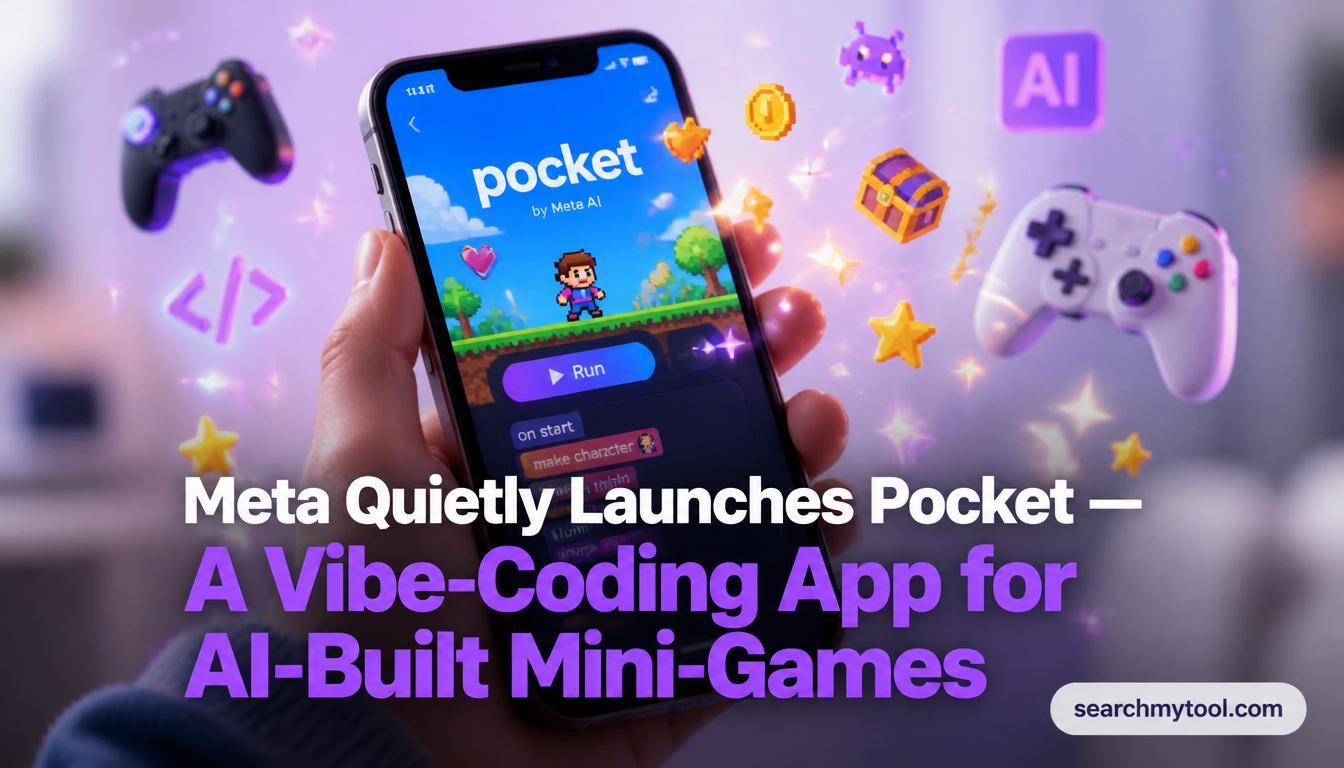
No press release, no launch event — just an app quietly appearing on the App Store and Google Play. Meta’s Pocket turns a single text prompt into a playable, shareable mini-game in seconds, and it may signal where AI creativity is heading next.
Meta did not announce it. There was no keynote, no press release, no TechCrunch exclusive timed to a publicist’s embargo. The company’s new app, Pocket, simply appeared on the Apple App Store and Google Play on June 29, 2026 — and was spotted three days later by Alessandro Paluzzi, a reverse engineer who regularly digs through app store listings looking for exactly this kind of stealth launch. By the time it hit the tech press on July 2, the app had already been live for days.
Pocket describes itself as “a creative platform for making and sharing gizmos.” A gizmo, in the app’s language, is a small interactive experience — a mini-game, a toy, a playable thing — that you build not by writing code, but by typing what you want. “A game where a blooming flower acts as your paintbrush.” “A physics obstacle course you control by tilting your phone.” “A tiny puzzle starring a space cat.” Type the prompt, and the AI builds a playable version in seconds. Then scroll a TikTok-style feed and play what everyone else built.
Where It Came From: The Gizmo Acquisition
Pocket is not a product Meta built from scratch. The app comes directly from the team behind Gizmo — a vibe-coding gaming platform built by Atma Sciences — which Meta quietly acquired earlier in 2026. The original Gizmo app is still live in app stores and looks strikingly similar to Pocket; both offer the same prompt-to-game creation flow and a discovery feed for browsing other people’s creations. Pocket’s Android package name even retains its original branding: com.facebook.gizmo.
Gizmo had already found a real audience before Meta absorbed it. App intelligence firm Appfigures tracked 635,000 lifetime installs and a 98% positive sentiment rating — unusually strong numbers for an indie creative app, and exactly the kind of signal that would catch Meta’s attention. Rather than simply shutting Gizmo down and absorbing the technology into Instagram or Facebook, Meta has turned it into a standalone product — a pattern the company has used before, most recently with the disappearing photo app Instants, which is similarly being cross-promoted within Meta’s existing apps.
“The funny thing is that most people don’t actually want to learn game development — they just want to bring a fun idea to life.”
— Digital Trends, on the appeal of vibe-coded gaming
How It Works
The creation side is as simple as the pitch suggests: describe what you want, get a playable game. The AI can generate experiences that respond to touch, device sensors like the gyroscope, sound effects, and even the live camera feed. There is no coding, no game engine to learn, and no debugging. You either like what it built or you tweak the prompt and try again.
The social side is what makes it stickier than a pure creation tool. Gizmos go live on a scrollable feed — algorithmically curated, play-anywhere — where users can try, like, and remix games others have made. It is closer to TikTok or Reels than to Roblox or Unity: the consumption experience is passive and frictionless, the creation experience is a low-stakes invitation anyone can accept. That combination of easy creation and social discovery is the template for platforms that actually accumulate time-on-app.
Part of a Bigger AI Creativity Push
Pocket is the latest piece of a pattern that has been building at Meta through 2025 and 2026. The company launched AI-generated images through its Meta AI app, rolled out an AI video creation tool called Vibes, added AI generation features to its creator video-editing app Edits, and began testing Instants — a standalone disappearing-photo app — in European markets. Each of these is a standalone app or feature rather than a new tab in Facebook, and the strategy is consistent: test AI creation tools in contained, low-risk experiments before deciding whether to integrate them into the main platforms.
The market timing is not accidental. App Store submissions rose 84% in Q1 2026 compared to the same period last year — the largest quarterly surge in a decade — driven substantially by vibe-coded and AI-assisted apps. TikTok has been experimenting with its own mini-game feed. Sekai, a startup with a similar vibe-coded social gaming concept, raised $20 million in a Series A this year. The category is real, it is growing fast, and Meta is arriving with a product that already has a validated user base, an acquired team, and distribution infrastructure that no indie startup can match.
The Real Question: Are the Games Any Fun?
Creating an AI-generated game in seconds is an impressive trick the first time you see it. The harder question — whether AI-built gizmos are actually fun enough to play more than once, and whether the feed can surface enough quality content to retain users over weeks and months — is the one Pocket has not yet answered. The original Gizmo’s 98% positive sentiment and 635,000 installs are encouraging but represent a small, self-selected audience of early adopters who sought the app out. Mainstream retention is a different challenge entirely.
Meta has not officially commented on the launch. Its help pages note that “availability and features vary widely by region,” and downloads remain limited in several major markets including the United States. The company’s strategy with apps like Instants and Pocket appears to be low-key validation: release quietly, watch what the data shows, decide whether to accelerate or fold. Pocket is an experiment in public — and the experiment has only just started.