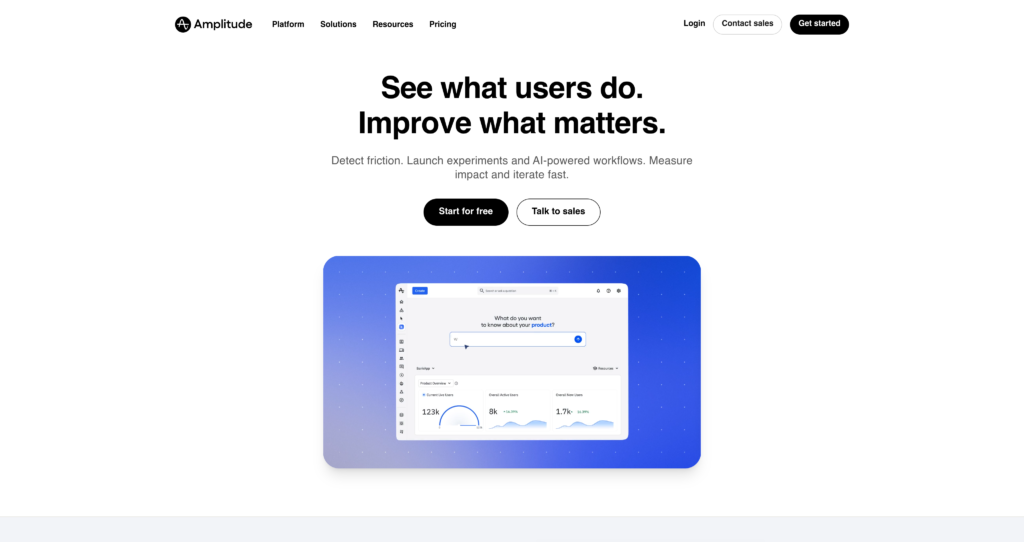
About amplitude
amplitude Amplitude functions as a comprehensive digital analytics platform designed for product, marketing, and engineering teams to understand how users interact with their applications. It aggregates event-level data to provide granular visibility into user journeys, allowing organizations to pinpoint exactly where users drop off or engage most deeply. The platform is widely utilized by businesses aiming to drive retention, increase conversion rates, and personalize customer experiences based on actual behavior. By unifying data from web and mobile sources, it creates a single source of truth for organizational decision-making. It is a powerful tool for teams that need more than basic page-view metrics to understand complex user paths.
Technically, the platform operates through a robust event-tracking architecture that captures every user interaction, which is then processed through a proprietary behavioral engine. This system allows for complex multi-dimensional querying, such as segmenting users by specific actions or defining cohorts based on recurring behavior patterns. Unlike traditional web analytics tools that focus on vanity metrics, it emphasizes individual user journeys and cross-platform identity resolution to maintain consistent data across sessions. Its predictive modeling components leverage historical usage data to forecast trends and identify at-risk user groups. However, a significant limitation is the steep technical learning curve required to implement effective event tracking, which often demands a disciplined approach to data governance and taxonomy design.
Key Features
Product Analytics : Visualize the entire user journey through event-based tracking. This allows teams to identify bottlenecks and optimize specific steps within a product flow.
Session Replay : Combine qualitative session recordings with quantitative data. This feature helps developers see exactly what a user experienced during a technical issue or drop-off.
Feature Experimentation : Deploy and manage feature flags alongside A/B testing capabilities. Teams can release features to specific cohorts to measure impact on metrics before a full rollout.
Behavioral Cohorts : Create dynamic groups of users based on their specific actions within the product. This enables highly targeted marketing and product messaging based on actual behavior.
AI Assistant : Utilize natural language queries to extract insights from complex datasets. This streamlines the analysis process for team members who are not proficient in SQL.
Data Governance : Maintain a clean and reliable data taxonomy across the entire organization. This ensures that metrics remain consistent as the business scales and adds new events.
Pros
✔ High-fidelity tracking of individual user journeys.
✔ Powerful behavioral segmentation and cohort analysis.
✔ Integrated A/B testing and feature flagging suite.
✔ Comprehensive cross-platform data unification.
✔ Scalable architecture suitable for growing startups and enterprises.
✔ Extensive library of integrations with third-party tools.
Cons
✖ Steep learning curve for proper event instrumentation.
✖ Complex taxonomy design requires dedicated technical resources.
✖ Significant cost increases as data volume scales.
✖ Limited offline support for event analysis.
✖ Initial setup can be time-consuming compared to basic analytics tools.
✖ The depth of features can be overwhelming for beginners.
Plans & Pricing
| Plan | Type | Price | Usage Limit | Inclusions |
|---|---|---|---|---|
| Starter ⚠️ | Free | Free | 10K MTUs, 2M events | Basic analytics, templates, session replay, unlimited feature flags, and community access. |
| Plus | Monthly | Starting at $49/mo | Up to 300K MTUs or 25M events | Everything in Starter plus unlimited product analytics, behavioral cohorts, and segmentation. |
| Growth | Custom | Contact Sales | Custom MTU/Event volume | Advanced behavioral analysis, causal insights, predictive audiences, and real-time streaming. |
| Enterprise | Custom | Contact Sales | Custom MTU/Event volume | Cross-product analysis, advanced data controls, mutual exclusion groups, and dedicated account management. |
FAQs
Q1: What is an MTU in Amplitude?
An MTU stands for Monthly Tracked User, which is a unique user who has performed one or more events within your application during a calendar month.
Q2: Can I use Amplitude for free?
Yes, Amplitude offers a generous Starter plan for individuals and small teams that includes up to 10K MTUs and 2M events per month.
Q3: Does Amplitude support A/B testing?
Yes, through the Feature Experimentation and Web Experimentation modules, users can conduct A/B/n tests and manage feature flags directly.
Q4: Is Amplitude suitable for mobile apps?
Absolutely, Amplitude is designed to track events across both web and mobile platforms, providing a unified view of the user journey.
Q5: What happens if I exceed my event limit?
If you are on a paid plan, exceeding limits usually triggers an overage or requires a move to a higher volume tier; it is recommended to discuss your needs with sales as you scale.
Published on: June 19, 2026