A Beijing startup backed by Alibaba has released the world’s largest open-weight AI model — 2.8 trillion parameters, open weights dropping July 27, and benchmarks that put it ahead of GPT-5.6 Sol on coding while closing within striking distance of Claude Fable 5.
The open-source AI leaderboard just changed. Moonshot AI — the Beijing-based startup backed by Alibaba — released Kimi K3 on July 16, 2026, a 2.8 trillion-parameter Mixture-of-Experts model that the company describes as the world’s first open 3T-class AI system. The claim to that title is legitimate: at 2.8 trillion total parameters, K3 is 75% larger than DeepSeek’s previous record-holder at 1.6 trillion, and no open-weight model has come close.
The launch is timed almost perfectly for Moonshot’s purposes. It arrives one week before the 2026 World Artificial Intelligence Conference in Shanghai, one month after the US government’s temporary restrictions on Anthropic’s Fable and Mythos models shook global confidence in American AI supply chains, and at a moment when China’s open-source AI community is demonstrating, release by release, that the capability gap with frontier American models has narrowed far faster than most Western analysts expected.
What Kimi K3 Is
K3 is a Mixture-of-Experts model with 2.8 trillion total parameters organized into 896 expert subnetworks, of which only 16 activate per token — roughly 1.8% of the total pool. That extreme sparsity is what makes the model practical: despite its enormous parameter count, inference cost is comparable to a much smaller dense model, because most of the parameters are dormant for any given request.
The model features a 1 million-token context window, native vision understanding for text and image inputs, and an always-on reasoning mode with a tunable reasoning_effort control for balancing speed against depth. Two architectural innovations developed internally at Moonshot power the model: Kimi Delta Attention, a hybrid linear attention mechanism that reduces memory usage at long contexts, and Attention Residuals, which the company describes as a drop-in improvement to residual connections that delivers consistent scaling gains. Both were published as open research before K3’s launch.
The full model weights are due for public release by July 27. Until then, K3 is available through the Kimi app, Playground, and API at $3 per million input tokens and $15 per million output tokens — with a $0.30 per million rate on cache hits. That puts it below GPT-5.6 Sol ($5 input / $30 output) and significantly below Anthropic’s equivalent tier, though above some domestic Chinese competitors.
The Benchmarks: Strong, Honest, and Incomplete
Moonshot’s self-reported numbers place K3 firmly in the top tier of global models — and independent evaluators largely agree, with the usual caveat that independent verification of a model released 24 hours ago is necessarily preliminary.
| Benchmark | Kimi K3 | GPT-5.6 Sol | Claude Fable 5 | Verdict |
| Terminal-Bench 2.1 | 88.3% | 88.8% | ~88% | GPT-5.6 Sol (narrow) |
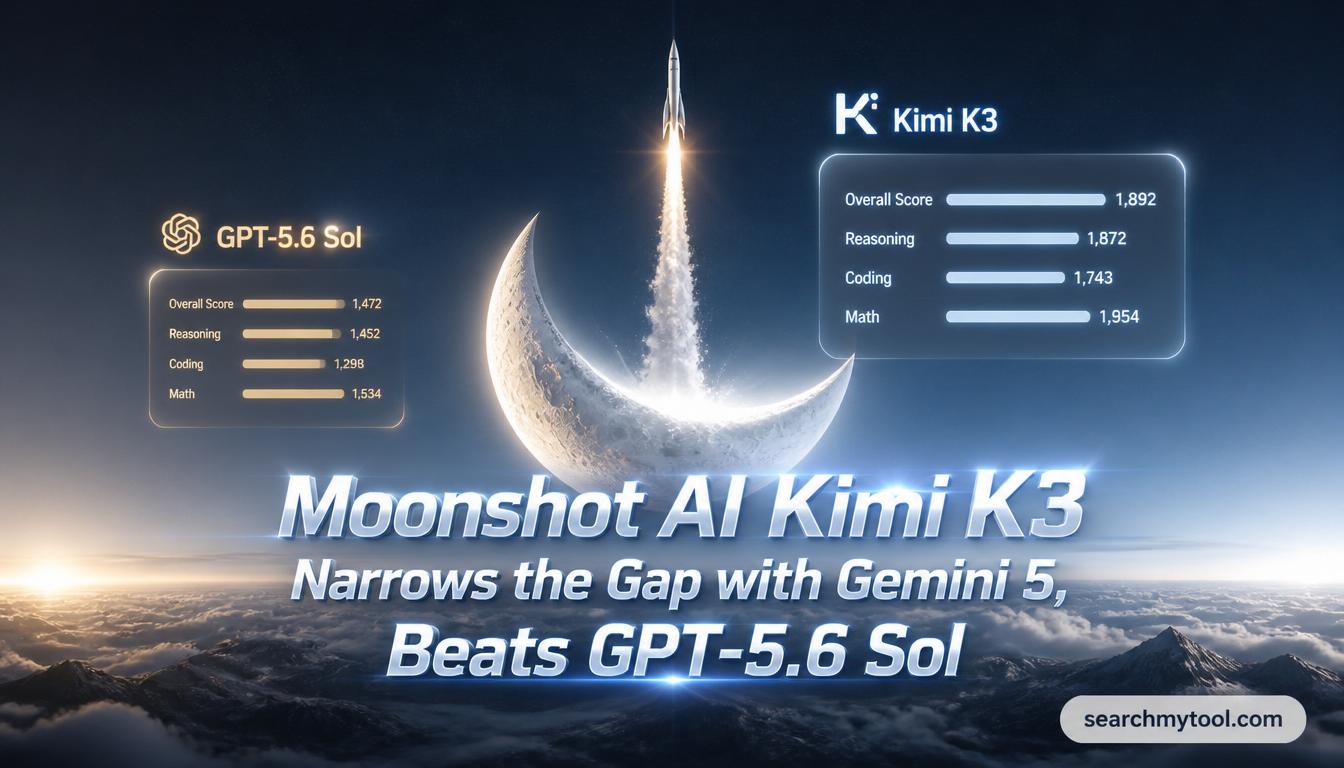
| GDPval-AA v2 (overall) | 1,687 | 1,747.8 | 1,815 | Fable 5 leads |
| Frontend Code Arena | #1 | Lower | Lower | Kimi K3 🏆 |
| Vals AI overall rank | 2nd | 3rd | 1st | Fable 5 leads |
| vs Claude Opus 4.8 | Beats | Beats | N/A | Both beat Opus 4.8 |
| vs GPT-5.5 | Beats | N/A | Beats | Both beat GPT-5.5 |
| Context window | 1M | 1.05M | 1M | Tie |
| API price (input/out) | $3/$15 | $5/$30 | N/A | Kimi K3 cheapest |
The most striking result from independent evaluators is K3’s first-place finish on Frontend Code Arena — a blind developer testing benchmark for web interface construction — where it scored 1,679 points, edging out Claude Fable 5. That result surprised observers who expected the ranking to mirror general capability scores. On Terminal-Bench 2.1 — the benchmark measuring real-world agentic coding — K3 scores 88.3% against GPT-5.6 Sol’s 88.8%, a gap of half a percentage point. For a model with open weights releasing in eleven days, that is an extraordinary result.
The honest picture: K3 does not beat Fable 5 overall. On GDPval-AA v2 — which tests real-world tasks across 44 occupations and 9 industries — K3 scores 1,687 against Fable 5’s 1,815 and Sol’s 1,747.8. Vals AI ranks K3 second overall, behind Fable 5 and ahead of GPT-5.6 Sol. Moonshot’s own positioning is direct: K3 closes in on Fable 5 and beats the rest. That framing is accurate.
“Moonshot, Z.ai, and MiniMax are shipping stronger models at sharply lower prices, undercutting the assumption that Chinese AI runs at least six months behind.”
— Technology.org, July 17, 2026
The Strategic Context: China’s Open-Source Moment
K3 does not exist in isolation. It arrives in the same week that VentureBeat catalogued a wave of Chinese model releases — Z.ai’s GLM-5.2, which matched Claude Opus 4.8 on coding at a fifth of the price; MiniMax’s in-progress 2.7 trillion-parameter model expected in Q3; DeepSeek’s V4 Pro at 1.6 trillion parameters — that collectively represent the most concentrated period of frontier open-source model releases China has ever produced.
The geopolitical timing is hard to overlook. The US government’s decision in June to temporarily restrict Anthropic’s Fable and Mythos models over cybersecurity concerns was intended partly to limit access to frontier AI outside the United States. K3’s release — open-weight, globally downloadable, running adequately on hardware available inside China’s export-restricted environment via a custom MiniTriton compiler built for Nvidia’s L20 card — demonstrates one of the limits of that strategy. You cannot restrict access to a model whose weights anyone can download.
Moonshot recommends serving K3 on supernodes of 64 or more accelerators to keep expert-parallel traffic inside a single high-bandwidth domain. The company built MiniTriton — a Triton-like compiler developed from scratch — specifically to optimize inference on the L20, the export-controlled card available in China. The fact that a frontier-class 2.8 trillion parameter model can run, in any configuration, on hardware China can actually buy is the point K3 makes most loudly.
Moonshot’s Comeback
For Moonshot specifically, K3 represents a dramatic recovery. The company’s earlier Kimi models — K2, K2.5 (1 trillion parameters, January 2026), K2.6 (April 2026) — had been competitive domestically but were not generating the kind of international attention that DeepSeek’s releases commanded. The launch of DeepSeek V3 and R1 had effectively reset the benchmark for what a Chinese open-source model could do, and Moonshot’s position in that competitive landscape had eroded.
K3 changes that story completely. Arena.ai’s first-place ranking in Frontend Code is not a domestic Chinese benchmark — it is the same evaluation suite used to compare Anthropic and OpenAI models globally. Vals AI’s second-place overall ranking, ahead of GPT-5.6 Sol, is the most visible independent validation yet that a Chinese open-weight model is competing at the very top of the global field rather than merely approaching it.
What Happens July 27
The weight release on July 27 is what will determine how significant K3 actually becomes. Right now, K3 is available through Moonshot’s API and app — useful, but controlled. When the weights go public, researchers worldwide can fine-tune it, quantize it, build on it, and run it locally. That is when Kimi K3 either becomes infrastructure — the foundation that a thousand derivative models are built on, the way Llama and DeepSeek became infrastructure — or fades into the long list of impressive-at-launch models that never accumulated community momentum.
The early signals are good. A model that ranks first in blind frontend coding tests, second overall in independent evaluation, and runs on export-controlled hardware with a custom compiler has done the hard work of being technically impressive. Whether the open-source community embraces it with the enthusiasm that Moonshot is clearly hoping for will be visible within days of the weights dropping.