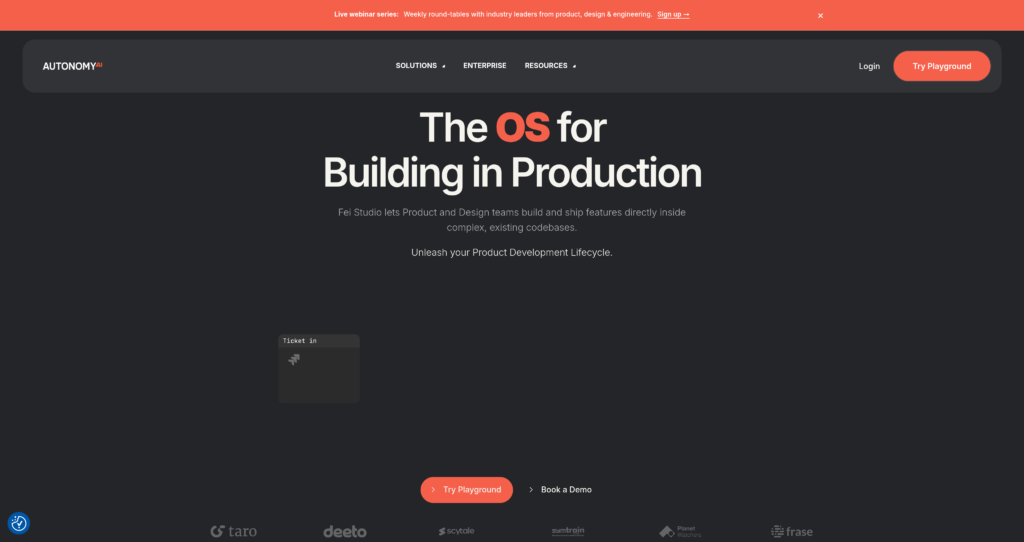
About autonomyai
autonomyai Autonomy AI is an advanced agentic platform designed to help developers, technical teams, and enterprises build and coordinate autonomous AI agents. Leveraging modern large language models, the platform enables users to design multi-agent systems capable of executing complex, multi-step tasks without continuous human intervention. Its primary use case revolves around automating repetitive operational workflows, customer interaction pipelines, and data processing tasks. By providing a structured environment for agent collaboration, it shifts the focus from simple text prompts to systemic task execution.
Under the hood, Autonomy AI utilizes a sophisticated orchestration layer that coordinates state management, memory, and tool usage across multiple specialized agents. This allows different agents to handle distinct parts of a process—such as research, analysis, and execution—while sharing context seamlessly. The platform provides a visual canvas alongside developer SDKs, making it versatile for both low-code and high-code environments. However, a notable limitation is the steep learning curve required to configure complex decision-making loops without causing infinite recursion or excessive API credit consumption.

Key Features
Visual Workflow Builder : A drag-and-drop canvas that lets users map out interactions between multiple AI agents and external tools visually. This simplifies the creation of multi-agent architectures without writing extensive boilerplate code.
State and Memory Management : Built-in short-term and long-term memory systems that allow agents to retain context across multi-step processes. This prevents the loss of crucial information during extended execution cycles.
Pre-built Tool Integrations : Out-of-the-box connectors for databases, CRM platforms, and standard APIs. This enables agents to read and write data directly to your existing software stack securely.
Custom Agent Coding SDK : A robust developer software development kit supporting Python and JavaScript. This allows engineers to program custom behaviors, prompt logic, and strict output constraints.
Multi-Agent Collaboration Protocols : Communication layers that allow autonomous agents to assign tasks, peer-review outputs, and resolve execution bottlenecks collectively. This ensures high-quality results for complex assignments.
Human-in-the-Loop Safeguards : Interactive approval gates that pause execution and prompt a human operator for validation before critical actions. This prevents agents from executing unintended external operations.
Execution Monitoring and Logging : Real-time dashboards tracking agent decisions, API usage, and operational costs. This provides complete transparency into the decision tree and token spend of each workflow.
Pros
✔ Excellent multi-agent orchestration capabilities for complex, multi-step processes.
✔ Flexible interface offering both low-code visual nodes and full SDK access.
✔ Human-in-the-loop triggers provide necessary compliance and safety gates.
✔ Dynamic context sharing prevents redundant LLM token utilization.
✔ Comprehensive debug logs make it easy to trace failed agent steps.
✔ Wide variety of pre-configured triggers and action nodes.
Cons
✖ Setup and optimization require a strong understanding of prompt engineering.
✖ High token consumption can quickly lead to unexpected API usage costs.
✖ The visual builder can become cluttered and difficult to navigate for massive enterprise workflows.
✖ Limited offline testing capabilities require active cloud connections to run agents.
✖ Free plan has strict usage caps that restrict complex testing scenarios.
✖ On-premise deployment options are locked behind high-tier enterprise agreements.
Plans & Pricing
| Plan | Type | Price | Usage Limit | Inclusions |
|---|---|---|---|---|
| Free ⚠️ | Monthly | Free | 3 agents, 1,000 runs/mo | Access to basic model integrations, standard visual editor, and community support. |
| Pro | Monthly | $49/mo | Unlimited agents, 15,000 runs/mo | Access to advanced LLM nodes, priority support, and custom webhook integrations. |
| Enterprise | Monthly | Custom | Unlimited runs | Dedicated deployment, custom SLA, advanced compliance features, and premium account management. |
FAQs
Q1: Does Autonomy AI support self-hosting?
Autonomy AI is primarily a cloud-hosted platform. However, self-hosting options and private cloud deployments are available under the Enterprise tier.
Q2: Can I use my own OpenAI or Anthropic API keys?
Yes, the platform allows you to connect your own API keys to optimize costs and use custom rate limits. This is highly recommended for scaling workflows efficiently.
Q3: How does the Human-in-the-Loop feature work?
You can place a human approval node before any critical action, such as sending an email or executing a transaction. The workflow will pause and send a notification, resuming only after approval.
Q4: Are my enterprise data and keys secure on the platform?
Autonomy AI uses enterprise-grade encryption for all stored keys and data in transit. Additionally, the platform does not use your operational data to train public models.
Q5: What programming languages does the SDK support?
The Autonomy AI developer SDK currently provides official support for Python and Node.js. This makes it highly compatible with modern backend services and automation scripts.
Published on: June 3, 2026