
About MarsX
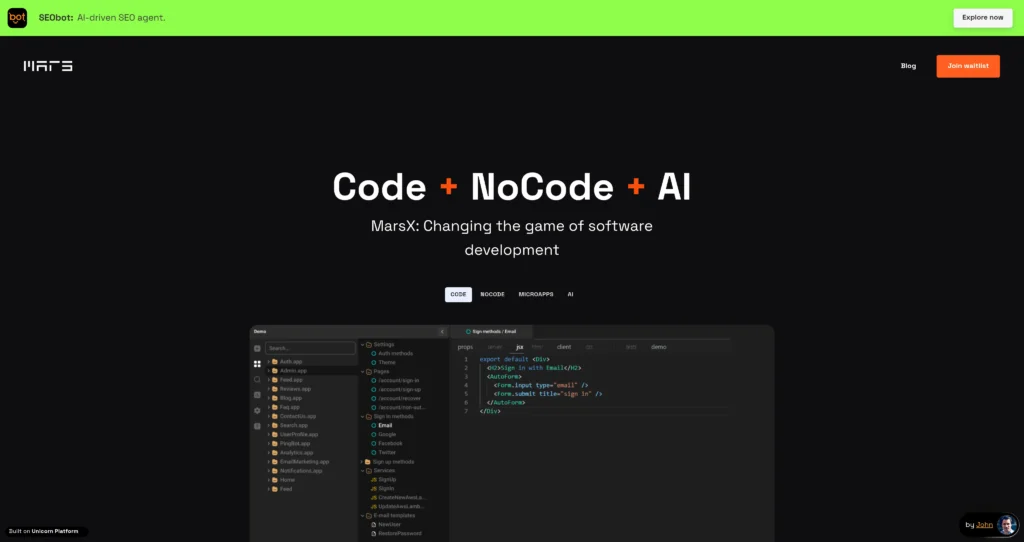
MarsX is an open-source software development platform that combines code, no-code, AI, and reusable MicroApps. It is designed to help builders create web apps, mobile apps, marketplaces, social networks, dashboards, CMS tools, admin panels, email marketing systems, push notification flows, and startup products faster than traditional full-stack development.
The core idea behind MarsX is full-stack reuse: instead of starting every feature from scratch, developers can use prebuilt MicroApps that include backend, frontend, database, admin, CMS, and related product logic. Teams can begin with no-code configuration, then switch into code when they need custom logic, making MarsX useful for founders, developers, agencies, startup studios, and teams that want both speed and ownership.
Key Features
Code + NoCode + AI workflow : Start with no-code building when existing MicroApps fit your use case, then move into code for custom logic without throwing away the work already done.
Reusable MicroApps : Use prebuilt full-stack modules for use cases like marketplaces, social networks, streaming portals, photo-sharing apps, collections, no-code builders, and Uber-for-X style products.
Full-stack development server : MarsX brings server, client, and database workflows into one development platform for faster product building.
Built-in product systems : Includes content management, administration, dashboards, email marketing, push notifications, and plug-and-play localization.
Open-source platform : The Mars engine is open-source, can be deployed locally or on your own server, and is designed to avoid vendor lock-in.
Custom code flexibility : Developers can use Mars IDE and JavaScript/TypeScript-style workflows to modify MicroApps, add business logic, and customize the platform when no-code configuration is not enough.
Cross-platform app building : MarsX is positioned for building web and mobile experiences from the same ecosystem, with reusable product logic across platforms.
Developer marketplace : Enterprise customers can get matched with Mars developers and experts for custom builds, support, and project delivery.
Pros
✔ Strong fit for startups and agencies that build common product patterns like marketplaces, dashboards, social apps, and internal tools.
✔ Lets teams start with no-code speed and move into code when customization becomes necessary.
✔ Full-stack MicroApps can save time compared with stitching together separate frontend and backend libraries.
✔ Open-source engine and self-hosting options reduce vendor lock-in concerns.
✔ Includes useful startup infrastructure such as CMS, admin, dashboards, email marketing, push notifications, and localization.
✔ Free plan gives teams access to the platform for MVP and scaling stages.
✔ Enterprise path can connect teams with experienced Mars developers for custom delivery.
Cons
✖ No-code building works best when your product fits existing MicroApps; highly custom ideas may still require coding.
✖ MicroApps are built by third parties and may have separate free or premium pricing models.
✖ Developers may need time to learn the Mars ecosystem, MicroApp structure, and Mars IDE workflow.
✖ Enterprise pricing is custom, so larger teams need to contact MarsX for exact costs and support terms.
✖ Teams with mature existing stacks may need to evaluate migration effort before adopting MarsX.
Plans & Pricing
| Plan | Type | Price | Usage Limit | Inclusions |
|---|---|---|---|---|
| Free | Free | $0/month | For startups at MVP and full-scale complexity stages | Cross-platform development server; server, client, and database in one; CMS, administration, dashboards, email marketing, push notifications, localization; deployment on your own or local server; open-source platform and MicroApps. |
| Enterprise | Custom | Custom quote | Unlimited developers according to pricing page | All startup package features plus dedicated support from Mars experts, custom quote, and help matching with Mars developers. |
| MicroApps | Marketplace / add-on note | Free or premium depending on the MicroApp | Varies by third-party MicroApp | The Mars engine is free and open-source, but individual MicroApps may have their own pricing models. |
Source: marsx.dev/pricing (verify on official website).
FAQs
Q1: What is MarsX used for?
MarsX is used to build web apps, mobile apps, marketplaces, dashboards, CMS systems, admin panels, social networks, streaming portals, and startup products with reusable MicroApps, no-code configuration, and custom code.
Q2: Is MarsX a no-code builder or a coding platform?
It is both. MarsX lets users start with no-code when existing MicroApps fit the project, then switch to code for custom logic, deeper modification, and advanced product requirements.
Q3: Is MarsX free and open source?
The official site says the Mars engine is free and open-source. However, MicroApps are built by third parties and can have free or premium pricing models.
Q4: Can I self-host MarsX projects?
Yes. MarsX says projects can be deployed on your own server, local server, or closed network, which helps reduce vendor lock-in.
Q5: Who should use MarsX?
MarsX is best for founders, startup studios, developers, agencies, and teams that frequently build common full-stack product patterns and want to reuse tested modules instead of writing everything from scratch.
Final Verdict
MarsX is a modular development platform that combines low-code visual editing with custom JavaScript. It is powerful for building and scaling web applications quickly, though it has a slight learning curve.
Created on: May 13, 2026
Last updated: July 12, 2026