

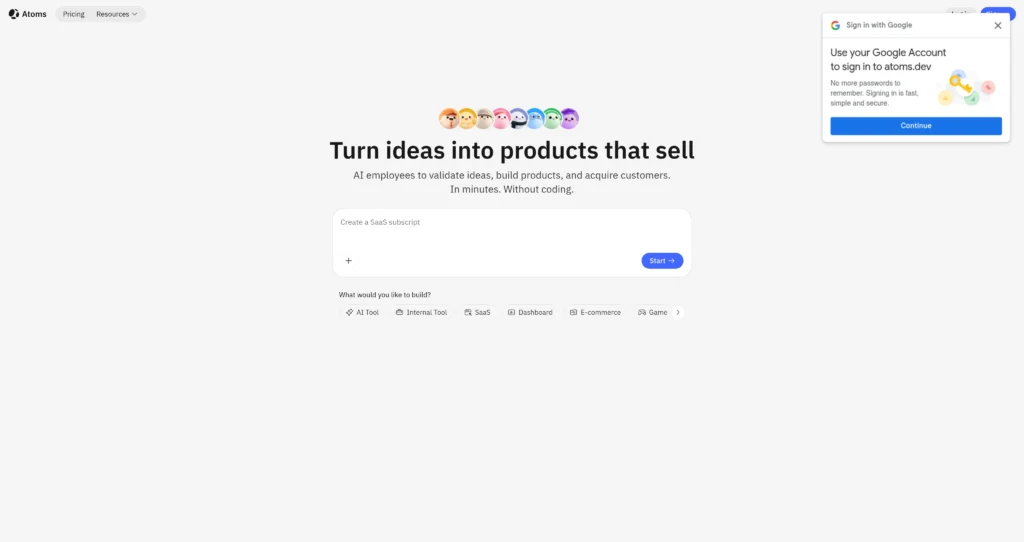
About Atoms
Atoms is an AI product-building platform that helps users turn natural language ideas into working apps, websites, dashboards, games, internal tools, and startup products. It positions itself as an AI team that can validate ideas, plan product direction, build software, test outputs, and help with customer acquisition workflows.
The platform is built for founders, builders, product managers, creators, and teams that want to move from concept to launch without spending weeks on setup, boilerplate, and manual coordination. Instead of only generating snippets, Atoms uses specialized AI agents for research, architecture, product planning, development, data analysis, and marketing, making it closer to a guided product studio than a simple code assistant.
Key Features
Multi-agent AI team : Specialized agents help with research, planning, architecture, coding, testing, and marketing so projects can move beyond single-prompt code generation.
Natural language product building : Describe what you want to build, then Atoms turns the idea into structured plans, screens, components, and working product logic.
Idea validation and research : Research-oriented agents help find demand, niches, competitors, and opportunities before users commit to building the wrong product.
Templates and remixable sessions : Start from product categories like SaaS apps, e-commerce, internal tools, dashboards, games, landing pages, and personal apps.
Live rendering and iteration : Preview changes quickly, refine outputs, branch ideas, undo steps, and continue improving the product through conversational edits.
Full-stack workflows : Supports app-building workflows that can include UI, backend structure, data models, integrations, and deployment-style steps depending on project scope.
Supabase and backend support : Helps translate product requirements into schemas and APIs for apps that need authentication, storage, or dynamic data.
Marketing and growth support : Atoms is not limited to code; it also emphasizes helping products sell through positioning, SEO, and customer acquisition workflows.
Pros
✔ Strong fit for founders and builders who want to turn ideas into working products quickly.
✔ Multi-agent workflow covers more of the product lifecycle than a basic code generator.
✔ Useful templates make it easier to start with SaaS, e-commerce, dashboards, internal tools, games, and landing pages.
✔ Research and validation features can reduce time spent building ideas with weak demand.
✔ Live previews, branching, and iteration help users refine projects without starting over.
✔ Free plan makes it possible to test the workflow before upgrading.
✔ Good option for non-technical founders, product teams, and developers who want faster prototyping.
Cons
✖ Credit limits can be restrictive for heavy builders on the Free plan.
✖ More advanced usage may require Pro or Max plans, especially for frequent product iteration.
✖ AI-generated products still need human review for security, performance, UX, and production readiness.
✖ Complex applications may require technical cleanup or developer oversight after generation.
✖ Pricing and credit rules can change, so users should verify the latest details on the official pricing page.
Plans & Pricing
| Plan | Type | Price | Usage Limit | Inclusions |
|---|---|---|---|---|
| Free | Free | $0/month | 15 credits/day and 25 credits/month | Forever-free access for light use and initial product-building experiments. |
| Pro | Subscription | Starts at $20/month | Flexible monthly tiers: 100 credits for $20, 250 credits for $50, 350 credits for $70 | Designed for professionals with daily high-frequency usage and more active product-building workflows. |
| Max | Subscription | Starts at $100/month | Flexible monthly tiers: 500 credits for $100, 1000 credits for $200, 1500 credits for $300, up to 10000 credits | Higher accuracy, more power and storage, plus Race mode that the official page says can improve accuracy up to 3x. |
| Credit rollover | Billing rule | Included based on plan rules | Unused credits may roll over for one billing cycle in specific cases | Credits can come from daily allocation, subscription credits, rewards, invite bonuses, or redemption codes; verify current rules in billing settings. |
Source: atoms.dev/pricing (verify on official website).
FAQs
Q1: What is Atoms used for?
Atoms is used to build apps, websites, dashboards, internal tools, games, landing pages, and startup products from natural language prompts using multiple AI agents.
Q2: Is Atoms a no-code tool or a coding tool?
It sits between no-code and AI development. Non-technical users can describe what they want, while technical users can use it for faster prototyping, architecture, and full-stack iteration.
Q3: Does Atoms have a free plan?
Yes. The Free plan is listed at $0/month with daily and monthly credits, making it suitable for light usage and trying the platform.
Q4: What are Atoms credits used for?
Credits are points used to access services inside Atoms. The official pricing page says the system uses daily credits first, then subscription credits, then bonus credits.
Q5: Can Atoms build production-ready products?
Atoms is designed to help users build working products quickly, but important projects should still be reviewed for code quality, security, privacy, performance, and deployment readiness before launch.
Published on: May 13, 2026