
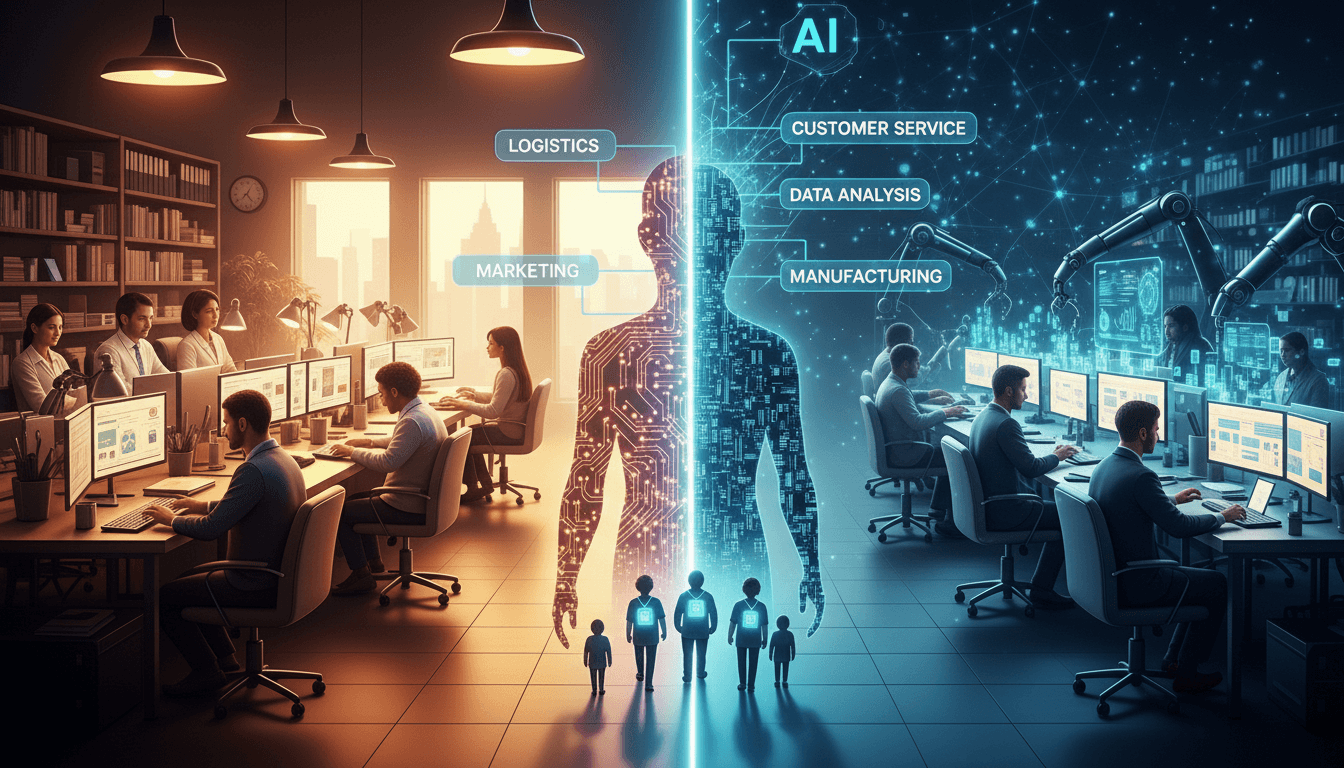
The numbers are real, but the story is more complex than the headlines suggest. By 2030, tens of millions of jobs will change — but the net outcome depends less on what AI can automate and more on how fast societies, companies, and workers can adapt. Here is what the data actually shows.
Every major technological transition in history has arrived with the same two companions: fear and opportunity. The steam engine, the assembly line, the computer — each was greeted with predictions of mass unemployment, and each ultimately created more jobs than it destroyed, though rarely for the same workers, in the same places, on the same timeline.
Artificial intelligence is different enough from its predecessors that the historical reassurance deserves scrutiny. Unlike previous technologies, which primarily automated physical or narrowly defined cognitive tasks, AI is encroaching on the broad, general cognitive labor — writing, analysis, coding, legal reasoning, customer judgment — that defines the modern white-collar economy. The scale of potential impact is correspondingly larger.
With 2030 now less than four years away, the forecasts are sharpening — and the picture they paint is not the apocalypse some fear, nor the frictionless abundance others promise. It is something more complicated: a massive structural shift that will play out unevenly across sectors, geographies, income levels, and generations, creating genuine hardship for some workers while expanding opportunity for others.
Understanding what will actually change requires cutting through the noise of both catastrophism and complacency. What follows is an evidence-based account of where things stand.
The Numbers: What the Forecasts Actually Say
No two forecasts agree precisely, because each makes different assumptions about the pace of AI adoption, the cost of automation, and the speed of organizational change. But across the leading research institutions, a rough consensus is forming.
Forrester, in its AI Job Impact Forecast published in January 2026, projects that 6% of US jobs — roughly 10.4 million roles — have the potential to be automated by 2030. Crucially, it also finds that 20% of jobs will be augmented by AI over the same period. The firm is explicit that this does not constitute an imminent apocalypse, but that its findings are “meaningful and worthy of attention.”
Goldman Sachs Research takes a similar view, estimating that 6–7% of the US workforce faces displacement risk under widespread AI adoption, with unemployment rising by roughly half a percentage point during the transition period as displaced workers seek new positions. The bank’s researchers are careful to note that this impact is expected to be temporary and historically consistent with disruptions caused by past technological transitions.
McKinsey’s research offers perhaps the most economically detailed picture: by 2030, approximately $2.9 trillion of economic value in the United States alone could be unlocked by AI and automation — provided organizations redesign workflows around people, agents, and robots working together, rather than simply eliminating headcount.
At the global level, the World Economic Forum’s Future of Jobs report projects that while 92 million positions may be displaced by 2030, 170 million new roles will emerge — a net gain of 78 million jobs, representing one of the largest employment expansions in modern history. Whether that net figure offers comfort depends largely on whether displaced workers can access the new roles.
Key Forecasts at a Glance
| Institution | Jobs at Risk / Displaced | Key Qualifier |
| Forrester (US) | 10.4 million (6%) | 20% of roles will be augmented |
| Goldman Sachs (US) | 6–7% displacement | Impact expected to be temporary |
| McKinsey (US) | $2.9T value at stake | Dependent on workflow redesign |
| WEF (Global) | 92M displaced | 170M new jobs created — net +78M |
| McKinsey Global Inst. | 14% career change | Due to AI, robotics & digitization |
| National Univ. (US) | 30% of jobs automatable | 60% face significant task changes |
These figures span a wide range — from conservative (Goldman Sachs) to expansive (National University / OpenAI) — reflecting genuine uncertainty. What is consistent across nearly every credible forecast is the underlying mechanism: it is not whole jobs that will be automated in most cases, but tasks within jobs. This distinction matters enormously for how workers and organizations should respond.
Who Is Most at Risk — and Who Is Least
The pattern of AI-driven disruption defies the assumptions that guided earlier rounds of automation. In the industrial era, automation displaced low-wage, manual, repetitive jobs. This time, the highest-exposure roles are concentrated in white-collar, knowledge-economy work — the jobs society has historically treated as safe.
High Exposure: The Surprising Vulnerability of White-Collar Work
Research from the University of Pennsylvania and OpenAI identified educated white-collar workers earning up to $80,000 a year as among the most likely to be affected. An AI researcher found that 80% of the US workforce could have at least 10% of their tasks affected by large language models, with roughly 19% facing disruption to half or more of their daily work.
The roles with the highest immediate exposure include customer service representatives (facing 80% automation potential by 2025, per SSRN research), data entry clerks (7.5 million positions globally at risk by 2027), retail cashiers (65% automation risk), and a range of back-office financial and legal roles. Goldman Sachs identifies computer programmers, accountants, auditors, legal and administrative assistants, and customer service representatives as the occupations with the highest displacement risk.
Even entry-level technology roles — once the gateway to upward mobility for university graduates — are showing early stress. Goldman Sachs research found that unemployment among 20- to 30-year-olds in tech-exposed occupations rose by almost 3 percentage points since the start of 2025, notably higher than for their same-aged peers in other fields. This corroborates widespread anecdotal reports that generative AI is contributing to a hiring slowdown for recent graduates in technology.
“Unlike past automation, which primarily targeted blue-collar work, large language models are poised to transform higher-wage, highly educated professions across multiple sectors.”
— SSRN AI Job Displacement Analysis, 2025
Low Exposure: The Resilience of Human Connection
At the other end of the spectrum, roles grounded in human connection, physical presence, and emotional intelligence remain substantially protected. McKinsey’s Skill Change Index — which measures automation’s potential impact across occupations — identifies interpersonal skills like negotiation, coaching, healthcare, and conflict resolution as the least exposed. The legal and financial sectors will undergo significant transformation, while education and healthcare will remain relatively resistant due to their reliance on human interaction and complex, context-dependent judgment.
The IMF has been particularly emphatic about this complementarity: AI systems strengthen the value of human judgment in areas like complex decision-making, pattern recognition with ethical implications, and knowledge synthesis across domains. The professionals who understand how to work with AI — interrogating its outputs, interpreting its results, catching its errors — are positioned to benefit most from the transition.
A Hidden Dimension: Gender and Geography
The distributional effects of AI automation carry important equity dimensions that aggregate statistics obscure. SSRN’s 2025 displacement analysis found that 58.87 million women in the US workforce occupy positions highly exposed to AI automation, compared to 48.62 million men — a significant gender disparity that reflects women’s higher concentration in customer-facing, administrative, and clerical roles.
Geographically, the IMF has flagged that AI’s impact will be concentrated in advanced economies, where digital infrastructure and white-collar job composition make automation more immediately viable. AI is expected to affect close to 60% of jobs in advanced economies, but only 26% in low-income countries — a disparity that is likely to widen global inequality over the short term.
The Jobs Being Created: The Other Half of the Story
The dominant media narrative around AI and employment focuses almost exclusively on displacement. The creation side of the ledger receives far less coverage, despite being at least as significant.
The most direct job creation is happening in AI itself. Approximately 350,000 new AI-related positions are emerging across industries — roles that did not exist five years ago. Prompt engineers, AI ethics officers, human-AI collaboration specialists, AI trainers, and machine learning operations engineers are now in high demand, commanding substantial compensation and offering strong long-term job security.
Beyond direct AI roles, the broader demand signal is shifting in ways that favor historically undervalued skills. Eight of the top ten most requested skills in US job postings are durable human skills: communication, leadership, metacognition, critical thinking, collaboration, and character — each appearing in roughly 15 million job postings annually. Employers expect creative thinking, resilience, flexibility, and emotional intelligence to rise sharply in importance by 2030.
The economic logic for this is straightforward. As AI handles more of the routine cognitive work, the scarcity value of skills that AI cannot replicate increases. The ability to exercise contextual judgment in ambiguous situations, to build trust with other humans, to navigate organizational complexity, and to ask the right questions — rather than generate answers from prompts — becomes more valuable, not less.
McKinsey finds that demand for AI fluency — the ability to use, manage, and critically evaluate AI tools — has grown sevenfold in two years, faster than for any other skill in US job postings. Workers who become genuinely skilled at AI collaboration rather than treating it as a point-and-click novelty are commanding a significant and growing wage premium.
The Task Shift: How Most Jobs Will Change Without Disappearing
The most important and most underreported insight from the research base is the distinction between job elimination and task transformation. The Forrester forecast and McKinsey analysis both emphasize that the primary mechanism of AI’s impact is not the wholesale replacement of jobs but the redistribution of tasks within jobs.
McKinsey’s Skill Change Index makes this concrete. More than 70% of today’s skills can be applied in both automatable and non-automatable work. This means that for most workers, AI will not make their skills obsolete — it will change where and how those skills are applied. Workers will spend less time on document preparation and basic research, and more time framing questions, interpreting results, and engaging in the judgment calls that require human experience and ethical accountability.
This is not uniformly comfortable. “Spending less time on X and more time on Y” sounds neutral in a report, but lived experience is harder. A paralegal who spent most of their career on contract review and now finds that task handled in minutes by AI must develop new competencies quickly — or watch their role contract around the smaller set of tasks that remain. The transition is real and, for many workers, genuinely difficult.
The numbers on required retraining reflect the scale of the challenge. National University research projects that 59% of workers will require upskilling or reskilling by 2030 — well over half the entire workforce. By 2030, 14% of employees globally will have been forced to change their career path entirely due to AI, robotics, and digitization. In the US alone, 20 million workers are expected to retrain in new careers or AI-related skills in the next three years.
The pipeline for that retraining remains inadequate. A critical bottleneck: 77% of the new AI-related jobs being created require a master’s degree or equivalent technical credentialing, while the workers most displaced by automation are disproportionately those without advanced degrees. This skills gap is not a problem that markets will solve on their own.
The Corporate Disconnect: Layoffs Without Readiness
One of the most striking findings from the current period is the gap between corporate rhetoric and operational reality. Throughout 2025, a wave of high-profile layoffs were attributed, at least in part, to AI — from Salesforce to Amazon to Workday. The message from CEOs was consistent: AI is replacing the need for certain roles.
Forrester’s research tells a different story about what is actually driving these decisions. When Forrester consultants speak to clients announcing AI-driven layoffs, they ask a simple follow-up question: do you have a mature, vetted AI application ready to fill those jobs? In nine out of ten cases, the answer is no — and many organizations haven’t even started building the replacement capability. Forrester’s conclusion is pointed: “Most of the layoffs are financially driven and AI is just the scapegoat, at least today.”
This matters because it means that much of the current employment disruption attributed to AI is not actually a product of AI capability — it is a product of corporate cost-cutting using AI as a socially acceptable rationale. The genuine AI-driven disruption, when it arrives at scale, will look different: it will happen in organizations that have successfully deployed capable AI systems, not in organizations that are downsizing in advance of building them.
The risk of this approach is significant. Firms that eliminate junior roles to reduce short-term costs face a long-term talent development crisis. Without entry-level staff, organizations lose the institutional knowledge pipelines, mentorship structures, and on-the-job training systems that develop the senior leaders of tomorrow. As Forrester’s J.P. Gownder has observed, over-automation can lead to “costly pullbacks, damaged reputations, and weakened employee experience” — reversals that have already begun in some sectors.
“To navigate the complexity around the human and AI era, leaders must prioritise governance and invest in their people, treating AI not as a replacement for human talent but as a tool to enhance it.”
— Forrester Research, AI Job Impact Forecast 2025–2030
Sector by Sector: The Specific Transformations Ahead
Finance and Banking
The banking sector faces the most concentrated disruption of any single industry. A Morgan Stanley report cited by the Financial Times projects that up to 200,000 Europe-based banking roles could be eliminated by 2030 as lenders focus more on AI and close physical branches. Goldman Sachs itself has identified financial processing and routine accounting as among the skills most likely to become largely AI-led. The roles that survive will shift toward exception handling, relationship management, and regulatory judgment — the work that requires human accountability.
Legal and Professional Services
Legal work has long been assumed to be protected by its complexity and the accountability requirements of the profession. That assumption is being tested. Routine legal tasks — contract review, due diligence, precedent research, compliance checking — are among the most directly in the path of language model automation. A research study found that legal secretaries, tax preparers, and paralegals are among the most exposed roles to LLM disruption nationally. What survives is the uniquely human dimension of legal work: courtroom advocacy, client trust, ethical judgment, and the exercise of professional discretion.
Manufacturing and Transportation
The SSRN displacement analysis projects that 2 million manufacturing positions and 1.5 million trucking jobs are at risk by 2030. For manufacturing, this continues a longer trend: 1.7 million jobs were lost to automation since 2000. For trucking, the primary driver is autonomous vehicle development, which has advanced more slowly than early projections but remains on track to reach commercial viability for long-haul routes within the 2030 timeframe.
Healthcare
Healthcare presents one of the clearest examples of AI as a net job creator rather than destroyer. Medical transcription is already declining (projected down 4.7% through 2033), and routine diagnostic support is increasingly AI-assisted. But the fundamental demand for human healthcare workers — driven by an aging global population, the need for physical care, and the irreplaceable value of the human therapeutic relationship — is growing faster than automation can offset it. AI in healthcare is, at least through 2030, primarily augmenting rather than replacing clinical roles.
Education is another sector where human interaction remains central and displacement risk is relatively low. AI tutoring systems are increasingly capable, but the relational, developmental, and pastoral dimensions of teaching — building trust, managing classrooms, mentoring adolescents, adapting to the emotional dynamics of individual students — resist automation. The teachers most at risk are those whose roles are primarily content-delivery; those who see themselves as learning architects and relationship builders are likely to find their value enhanced.
What Needs to Happen: A Policy and Organizational Agenda
The gap between the positive net-job forecast and the experienced reality of displaced workers is not bridged automatically. It is bridged by policy, investment, and organizational choices — and the evidence from previous technological transitions suggests that getting those choices right is harder than getting the technology right.
Invest in workforce transitions at scale. The IMF projects that over 40% of workers will need to develop new skills to remain employably competitive by 2030. Most corporate training budgets and public workforce development systems are not remotely sized for this. Closing that gap requires treating workforce development as infrastructure investment, not an employee benefit.
Protect the entry-level pipeline. Organizations eliminating junior roles to capture short-term AI efficiency gains are making a trade that looks attractive on a quarterly basis and damaging on a five-year horizon. The entry-level roles that AI is replacing were not just outputs — they were the training ground for the mid-level and senior talent organizations will desperately need in the decade ahead.
Close the credential gap. The finding that 77% of new AI jobs require advanced degrees is, at its core, a policy failure in the making. If the jobs of the future are inaccessible to workers without graduate education, the net-positive job creation figures become irrelevant for the majority of displaced workers. Expanding accessible, affordable pathways to technical AI skills is a prerequisite for the net positive outcome to be broadly shared.
Govern AI in the workplace. Workers facing AI-driven task changes or role eliminations benefit from transparency, fair process, and adequate transition support. Organizations that deploy AI against their workforce without these safeguards will face legal exposure, reputational damage, and the erosion of the trust that makes organizations function. Governance is not a constraint on AI adoption — it is the condition for sustainable adoption.
The 2030 Question
The question for 2030 is not whether AI will change work. It will — significantly, irreversibly, and sooner than most organizations have planned for. The question is whether the change produces a broadly shared improvement in human economic life, or whether it concentrates the gains among a narrow group of capital owners, technology companies, and highly credentialed workers while leaving everyone else behind.
The data is clear that the second outcome is not inevitable. The World Economic Forum’s forecast of 78 million net new jobs is not a fantasy — it is grounded in historical patterns of technological transition and reasonable assumptions about economic growth and AI-driven productivity gains. But it is also not automatic. It requires deliberate action from governments, corporations, educational institutions, and workers themselves.
The workers who will thrive in 2030 are not necessarily those with the most technical knowledge about AI — though that helps. They are those who can adapt, who have invested in skills that complement rather than compete with machines, and who work for organizations that view them as partners in a transition rather than liabilities to be eliminated.
As McKinsey summarizes: AI will not make most human skills obsolete. It will change how they are used. Whether that change is experienced as opportunity or loss will be determined, in large part, not by the technology — but by us.