About Deepgram
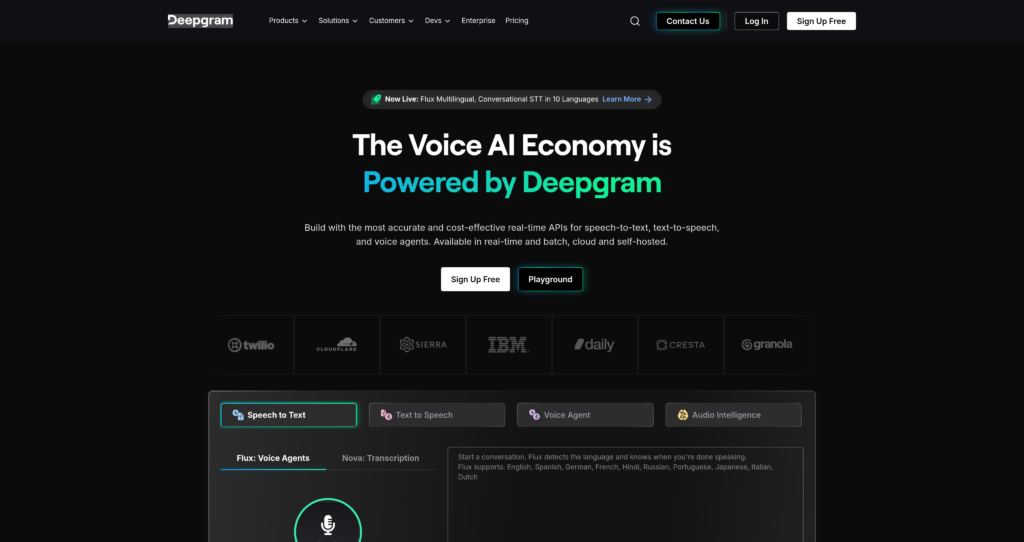
Deepgram Deepgram is an advanced, deep-learning-focused speech platform that provides highly scalable Speech-to-Text, Text-to-Speech, and conversational Voice Agent APIs. Built primarily for software developers, product engineering teams, and enterprise system architects, the service replaces conventional acoustic models with highly optimized end-to-end neural networks. It is commonly deployed to power real-time voice assistants, customer service intelligence engines, automated transcription services, and AI-driven speech interfaces. By processing multi-channel audio feeds in parallel, the platform delivers exceptionally fast transcript generation and vocal output capabilities.
Under the hood, Deepgram utilizes proprietary model architectures like Nova-3 and Aura-2 to convert spoken voice directly into formatted text or synthesize lifelike human voices. These models bypass traditional multi-stage pipeline bottlenecks, optimizing computational throughput to achieve ultra-low operational latency. Engineers can access the platform via robust REST and WebSocket endpoints designed to manage high concurrent connection spikes seamlessly. However, because it operates strictly as an API-first service, non-technical business users may experience a steep learning curve due to the lack of pre-built, user-friendly graphical interfaces.

Key Features
Nova-3 Speech-to-Text : An advanced neural speech recognition model trained on vast multilingual datasets. It processes noisy, multi-speaker, and far-field audio with minimal error rates, supporting over forty-five languages.
Aura-2 Text-to-Speech : An ultra-low latency vocal synthesis API optimized specifically for conversational AI systems. It produces highly realistic and fluid speech, minimizing the response gap in automated dialogue interfaces.
Real-Time Streaming : Enables continuous audio transcription over WebSocket Secure (WSS) connections. This allows developers to display live, streaming transcripts to users as the spoken words are being uttered.
Speaker Diarization : Identifies and segments different voices within a single audio stream, clearly labeling who said what. This feature is crucial for transcribing multi-party business calls and customer interactions accurately.
Smart Formatting : Automatically structures transcription outputs with proper punctuation, capitalizations, calendar dates, and financial figures. It saves developers significant effort by eliminating the need for post-processing scripts.
Voice Agent API : Facilitates natural conversational workflows with built-in turn-taking detection and proactive interruption management. It ensures that voice assistants behave intuitively without rigid operational prompts.
Audio Intelligence Tools : Extracts metadata such as summarization, topic detection, and sentiment analysis directly from processed speech files. This feature transforms raw acoustic data into highly structured analytical intelligence.
Pros
✔ Exceptionally low processing latency for both streaming transcription and vocal synthesis.
✔ High concurrency limits on WebSocket endpoints suitable for enterprise-scale traffic.
✔ Outstanding transcription accuracy even in noisy and far-field microphone environments.
✔ Generous initial credit pool allowing comprehensive sandbox and API testing.
✔ Native smart formatting minimizes post-processing data-cleaning scripts.
✔ Flexible deployment options including cloud, private cloud, and on-premise.
Cons
✖ No default visual interface, requiring software development skills to set up and configure.
✖ Valuable intelligence features such as PII redaction and diarization incur added costs.
✖ The Whisper cloud API configurations are constrained by lower concurrent connection caps.
✖ Pricing and cost calculation for complex multichannel audio streams require careful monitoring.
✖ Standard customer service is restricted to community and Discord channels on basic tiers.
✖ Advanced custom model training is restricted behind higher-volume enterprise agreements.
Plans & Pricing
| Plan | Type | Price | Usage Limit | Inclusions |
|---|---|---|---|---|
| Pay As You Go ⚠️ | Monthly | $200 free credit, then usage-based | Up to 50 REST API concurrency | Access to all public model endpoints, community & Discord support channels, standard uptime SLAs, and basic concurrency thresholds. |
| Growth | Yearly | $4,000+/yr | Up to 225 WSS API concurrency | Up to 20% savings via pre-paid yearly credits, enhanced concurrent channel limits, standard uptime SLAs, and access to all public model endpoints. |
| Enterprise | Custom | Contact Sales | Custom scale & deployment | Custom volume discounting, HIPAA compliance with BAAs, private cloud or on-premise deployments, dedicated support, and custom model training options. |
FAQs
Q1: How does Deepgram calculate speech-to-text pricing?
Deepgram charges on a per-minute basis for Speech-to-Text streaming and pre-recorded audio. Pricing scales according to the specific model chosen, such as Flux or Nova-3, with extra features like redaction billed as add-on fees.
Q2: What is included in the $200 free credit?
The $200 free credit provides developers full access to Deepgram’s public API endpoints, including Nova-3 and Aura-2. It allows teams to test speech-to-text, text-to-speech, and voice agent features under Pay As You Go concurrency limits without upfront commitments.
Q3: Does Deepgram support real-time audio streaming?
Yes, Deepgram provides real-time streaming capabilities via high-concurrency WebSocket Secure (WSS) endpoints. This supports ultra-low latency applications, live turn detection, and active conversation monitoring.
Q4: Can I deploy Deepgram on-premise?
Yes, Deepgram offers self-hosted, private cloud, and on-premise deployment options for Enterprise-tier customers. This is ideal for organizations with strict data residency, privacy, or ultra-low-latency local network requirements.
Q5: Is Deepgram HIPAA and SOC 2 compliant?
Deepgram is SOC 2 Type 1 and Type 2 certified, and fully compliant with GDPR regulations. Additionally, they sign Business Associate Agreements (BAAs) for Enterprise tier clients requiring HIPAA compliance for electronic protected health information.
Published on: June 6, 2026