

About Replicate
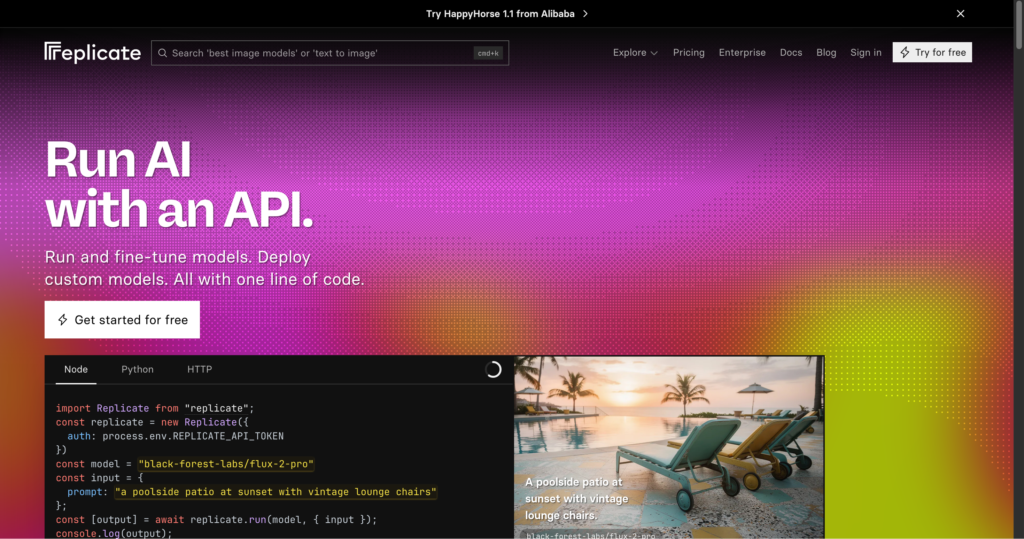
Replicate is an AI model hosting and API platform that lets developers run machine-learning models with a small amount of code. Its catalog includes thousands of public and proprietary models for image generation, video, speech, music, restoration, captioning, and large language model tasks. Developers can test models in a playground and call them through Python, Node.js, or HTTP APIs without managing the underlying GPUs.
Replicate also supports fine-tuning models with custom datasets and deploying private models packaged with its open-source Cog tool. Infrastructure scales up with demand and can scale to zero when unused, while logs and metrics help teams inspect production behavior. Readers comparing developer infrastructure can also explore Together AI, more AI development tools, and image generation platforms.
Key Features
Production model APIs : Runs public and proprietary models through consistent APIs instead of requiring local environment and GPU setup.
Large model catalog : Covers image, video, audio, music, speech, language, captioning, restoration, and other machine-learning tasks.
Playground comparison : Tests and compares model outputs before developers commit to an API integration.
Model fine-tuning : Trains supported models with custom people, products, objects, styles, and domain datasets.
Custom model deployment : Packages private models with Cog and deploys their dependencies, API server, weights, and prediction code.
Automatic scaling : Adds capacity when traffic grows and scales suitable workloads toward zero when demand stops.
Usage-based billing : Charges public models by runtime or input/output units and private deployments according to hardware uptime.
Logs and metrics : Tracks prediction activity, model performance, and individual requests to support debugging and monitoring.
Pros
✔ Provides one platform for thousands of models across many media and AI tasks.
✔ Python, Node.js, and HTTP options support common development stacks.
✔ Public models can be tested without setting up CUDA, dependencies, weights, or API servers.
✔ Fine-tuning and private model deployment support specialized production use cases.
✔ Autoscaling helps match infrastructure capacity to changing application demand.
✔ Model pages show task-specific cost estimates before users run workloads.
Cons
✖ Pricing differs by model, runtime, hardware, input, and output, so costs require workload-specific estimates.
✖ Most private deployments bill setup, idle, and active instance time.
✖ Community model quality, maintenance, licensing, and security can vary.
✖ Cold starts and shared queues may affect latency for some model configurations.
✖ High-volume video generation and dedicated GPU deployments can become expensive.
✖ Teams must review each model’s license and usage restrictions before commercial deployment.
Plans & Pricing
| Service | Type | Price | Usage Limit | Inclusions |
|---|---|---|---|---|
| Public Models | Pay as you go | Varies by runtime or input/output | Usage-based | Access to public and proprietary models with model-specific estimates shown on each page. |
| Image Examples | Per output | Flux Dev $0.025/image; Flux 1.1 Pro $0.04/image | Per generated image | Representative image-generation rates; each model has its own current price. |
| Video Examples | Per output second | Wan 2.1 480p $0.09/sec; 720p $0.25/sec | Based on output duration | Representative image-to-video pricing from the official pricing page. |
| Private Model Hardware | Compute time | T4 $0.81/hr; L40S $3.51/hr; A100 $5.04/hr; H100 $5.49/hr | Instance uptime | Dedicated hardware for custom models, generally including setup, idle, and active time. |
| CPU Hardware | Compute time | From $0.09/hour | Instance uptime | Small CPU begins at $0.000025 per second; larger CPU is listed at $0.36 per hour. |
| Enterprise | Custom | Contact sales | Custom scale and requirements | Support for larger organizations, production scale, security requirements, and committed infrastructure arrangements. |
Source: Replicate pricing. Verify each model’s live estimate, hardware rate, billing unit, idle-time behavior, and license before deployment.
FAQs
Q1: What is Replicate used for?
Replicate is used to run AI models through APIs, compare models, generate media, fine-tune models with custom data, and deploy private machine-learning code.
Q2: Is Replicate free?
Replicate lets users get started and try models, but production usage is generally pay as you go. Costs depend on the selected model, hardware, runtime, and input or output.
Q3: How does Replicate pricing work?
Most public models are billed for runtime, while others charge by input and output units. Private models usually charge for the entire time dedicated instances are online.
Q4: Can I deploy my own model?
Yes. Cog packages a model’s environment and prediction interface so Replicate can deploy it as a scalable API on supported cloud hardware.
Q5: Can Replicate fine-tune models?
Yes. Supported trainers can fine-tune models with custom datasets for specific people, products, objects, visual styles, or other specialized tasks.
Q6: Does Replicate scale automatically?
Replicate can automatically add capacity as traffic increases and reduce capacity when demand falls. Exact scaling and idle billing behavior depend on the deployment type.
Published on: July 5, 2026