

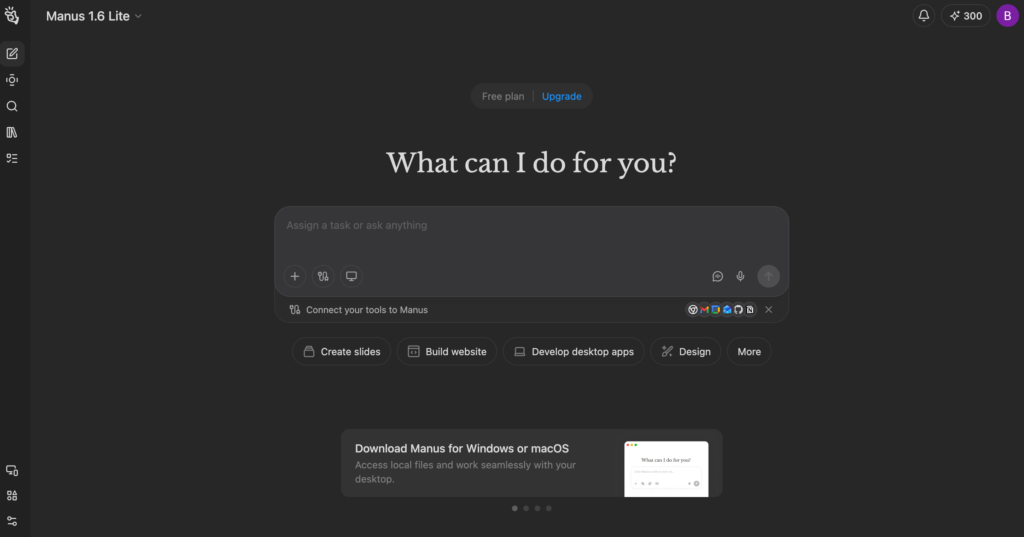
About Tool
Manus represents a paradigm shift from traditional AI chatbots by operating as an autonomous AI agent that actually completes entire workflows—building full-stack apps with databases and Stripe integration, conducting deep multi-layered research with source citations, generating professional presentations, and executing code in sandbox environments—all running asynchronously in the cloud background so users can assign tasks and return later to completed results. Originally created by Butterfly Effect (the team behind Monica.im) and launched in March 2025, Manus was acquired by Meta in late 2025 for approximately $2 billion, bringing significant infrastructure and expanding features to include desktop apps, Slack/WhatsApp/Telegram integrations, and enhanced collaboration tools.
Unlike conversation-focused tools like ChatGPT or Claude that generate text responses, Manus uses a multi-agent system with live dashboards streaming real-time actions—showing which pages it opens, searches it runs, code it writes, and forms it fills—while maintaining long-term memory through cloud-based file storage that recalls past tasks and preferences across sessions, making it ideal for researchers, analysts, developers, and teams needing production-ready outputs rather than just AI-generated suggestions.
Key Features
Autonomous Multi-Agent System : AI agents independently plan, execute, and manage complex multi-step tasks without human intervention, making architectural decisions about database schemas, API design, and implementation.
Full-Stack Web App Builder : Creates functional websites and applications with built-in databases, Stripe payment integration, SEO optimization, and deployment capabilities from single prompts.
Deep Research with Wide Research Mode : Conducts autonomous multi-layered research browsing websites, extracting data, creating comparison tables, and generating structured reports with source citations outperforming standard chatbots.
Live Computer Dashboard : Real-time streaming interface showing AI agent’s actions—pages opened, searches run, snippets copied, code written—with VS Code-style workspace view tracking files, logs, and scripts.
Code Execution Sandbox : Runs generated code in secure sandbox environment for data processing, API integrations, testing scripts, and full vibe coding cycles from writing through execution.
AI Slide Generation : Automatically creates professional presentations with deep insights, clear structure, and branded design from research data or topic prompts.
Persistent Long-Term Memory : Cloud-based file system maintains episodic records, checklists, and how-to knowledge enabling recall of past actions, preferences, and progress across different sessions.
Team Collaboration & Integrations : Shared credit pools, collaborative workspaces, admin controls, and seamless integration with Google Calendar, GitHub, Notion, Slack, WhatsApp, Telegram for workflow automation.
Pros
✔ Asynchronous cloud execution allows assigning tasks and returning to completed results
✔ Excels at deep research and data analysis outperforming ChatGPT on research depth
✔ Live dashboard transparency shows exactly what AI agent does in real-time
✔ Automatically generates downloadable files (.doc, .csv, .pdf) not just text responses
✔ Persistent memory recalls instructions and preferences across long conversations
✔ Free tier genuinely functional with 300 daily credits and 1,000 starter credits
✔ Meta acquisition brings significant resources and infrastructure improvements
Cons
✖ Credit system unpredictable—no way to know task cost before execution
✖ Complex tasks consume 500-900 credits meaning only 4-8 real tasks per $20 plan
✖ Unused credits vanish at month-end with no rollover causing significant waste
✖ Tasks stop immediately when credits deplete mid-execution wasting incomplete work
✖ App building buggy and unreliable for production—stick to prototyping only
✖ Agent loops or unnecessary API calls drain credits with no automatic cutoff
✖ More autonomy means less control over architectural and implementation decisions
Plans & Pricing
| Plan | Type | Price (Monthly) | Monthly Credits | Inclusions |
|---|---|---|---|---|
| Free | Forever Free | $0 | 300 daily + 1,000 starter | Chat mode access, Manus 1.6 Lite in Agent mode, 1 concurrent task, 2 scheduled tasks, basic features exploration, suitable for testing simple questions |
| Standard (Pro) | Subscription | $20 ($17 annual) | 4,000 | Chat & Agent modes (Manus 1.6, 1.6 Max, 1.6 Lite), advanced research, professional website deployment, slide generation, Wide Research, 20 concurrent tasks, 20 scheduled tasks |
| Customizable | Subscription | $40 | 8,000 | Double credits, adjustable allocation based on needs, everything in Standard, suitable for heavy users needing flexibility, priority processing |
| Extended Monthly Usage | Subscription | $200 | 40,000 | 5x Standard credits, designed for agencies/consultants running multiple client tasks, large research jobs, high-volume project generation, beta feature early access |
| Team/Enterprise | Custom | Contact Sales | Shared pool | Per-seat pricing, shared team credit pool, team collaboration, admin controls, SSO, priority support, SOC 2 compliance, unified billing, usage dashboards, add-on credits available |
FAQs
Q1: How does Manus differ from ChatGPT or Claude?
While ChatGPT and Claude focus on conversation and text generation, Manus is an autonomous agent that completes entire workflows. It independently browses websites, runs code in sandboxes, builds full-stack apps, conducts deep research, and executes multi-step tasks asynchronously in the cloud. Manus only makes sense if you need workflows completed autonomously rather than just AI-generated text or suggestions.
Q2: Why is the credit system considered problematic?
Major issues: (1) No way to estimate task cost before execution—you gamble on every task, (2) Complex tasks consume 500-900 credits unpredictably, (3) Unused credits vanish monthly with no rollover, (4) Tasks stop immediately when credits deplete wasting incomplete work, (5) Agent loops drain credits without automatic cutoff. At $20/month for 4,000 credits, you may get only 4-8 real tasks—potentially $2.50-5 per task.
Q3: Is Manus reliable for building production apps?
No. While Manus can create full-stack web apps, output quality is too buggy and unreliable for production use according to extensive testing. It excels at standard UI patterns but struggles with novel or complex business logic. Use Manus for prototyping and internal tools only. For production apps, use specialized builders like NxCode, Cursor, or Lovable.
Q4: What are Manus’s strongest use cases?
Manus excels at: (1) Deep autonomous research with source citations and structured reports, (2) CSV/Excel data analysis and visualization, (3) Professional report and slide generation, (4) Quick prototyping of web apps and internal tools, (5) Asynchronous task execution where you assign work and return to completed results. It’s particularly valuable when those tasks would take several hours manually.
Q5: How can I maximize credit efficiency?
Best practices: (1) Be specific with requests—”Research top 5 AI trends in healthcare for 2024″ vs vague “Research AI”, (2) Use free 300 daily credits for iterative improvements over multiple days, (3) Choose right agent type for task complexity, (4) Start with one feature and test before building everything at once, (5) Track usage in dashboard to understand which task types consume most credits.
Published on: April 5, 2026