OpenAI & Anthropic Hit Record Revenue Milestones
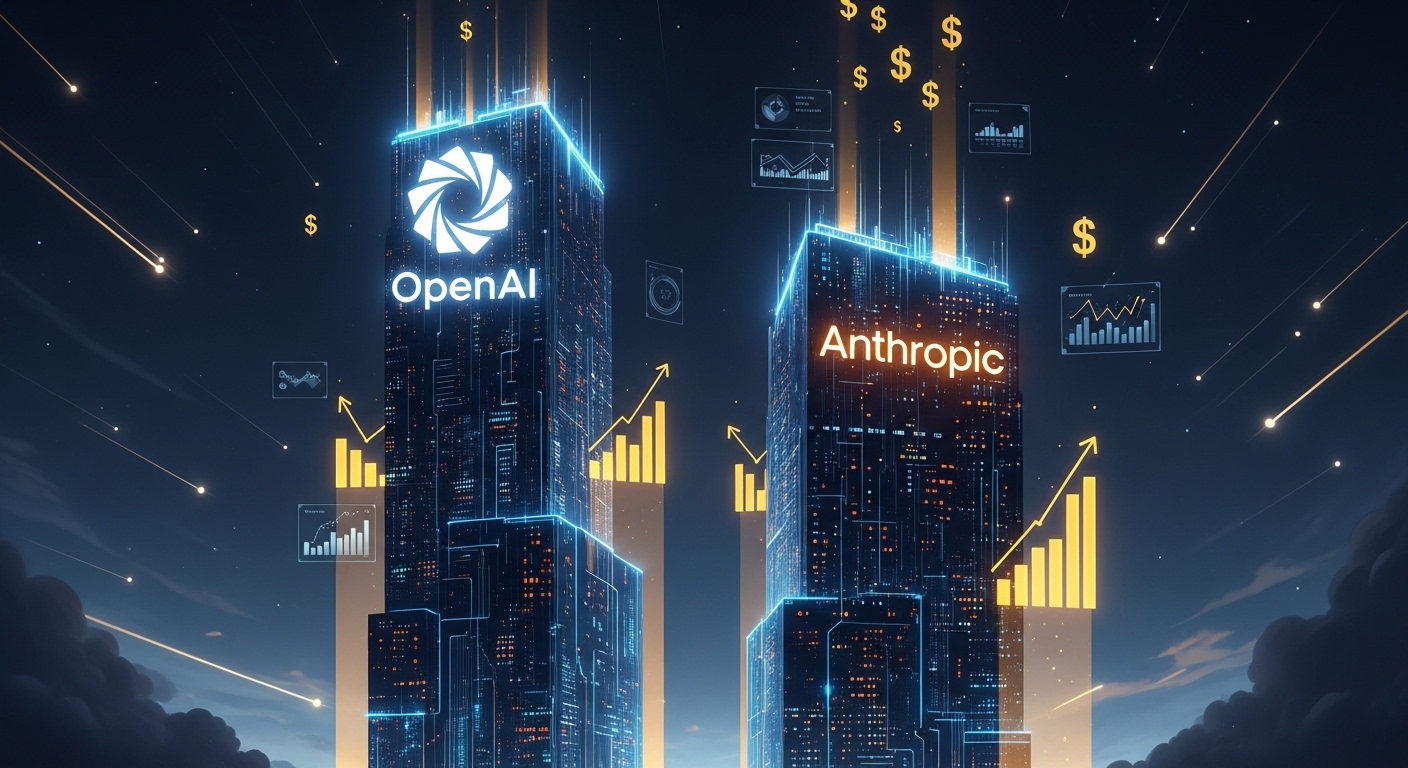
OpenAI’s annualized revenue has crossed $25 billion. Anthropic’s has nearly doubled in two months to $19 billion. Together, the two companies that define the AI era are on a revenue trajectory unprecedented in the history of private technology — and the race between them is just beginning.
| $25B+ OpenAI Annualized Revenue (Feb 2026) | $19B Anthropic Annualized Revenue (Mar 2026) | 10×Anthropic’s Annual Growth Rate |
Twelve months ago, skeptics were debating whether the AI boom was a bubble. Today, the two companies at the center of that boom are posting numbers that demand a different question: not whether the demand is real, but who wins the race to dominate the most valuable technology market of the century.
OpenAI, the San Francisco-based creator of ChatGPT, crossed $25 billion in annualized revenue by the end of February 2026 — more than doubling its full-year 2024 revenue in a single quarter. Anthropic, the safety-focused AI lab behind Claude, has achieved something arguably more remarkable: it doubled its annualized revenue from $9 billion to $19 billion in roughly eight weeks, a pace of growth that Epoch AI researchers describe as unprecedented in the history of enterprise software.
The numbers are all the more striking because both companies are reporting them while still burning billions in cash — a reminder that the race for AI supremacy is as much about capturing market share at breakneck speed as it is about near-term profitability. The companies that establish themselves as the default AI infrastructure for global enterprise by 2027 may never relinquish that position. That is the bet both companies are making, and the revenue trajectories suggest they are winning it.
OpenAI: The $25 Billion Juggernaut
OpenAI began 2026 by disclosing full-year 2025 revenue figures that confirmed what the ARR milestones had been signaling: the company has become one of the fastest-growing in technology history. CFO Sarah Friar confirmed in January that OpenAI’s annualized revenue for 2025 had exceeded $20 billion — a 230% increase from $6 billion in 2024 — before the run rate climbed further to surpass $25 billion by February’s end, according to reporting from The Information.
The engine of OpenAI’s growth is breadth. ChatGPT has become arguably the fastest-adopted consumer technology product in history, with weekly active users reaching 910 million by February 2026 — up from 700 million in July 2025 and 800 million in October. Paying business users have surpassed 9 million, up from 5 million in August. The consumer subscription tier, enterprise contracts, and developer API revenue together form a three-legged revenue base that no AI competitor has yet replicated at comparable scale.
OpenAI’s roadmap to $100 billion ARR by 2027 — a target cited in investor presentations — now seems less fantastical than it did a year ago, though it still implies a fourfold increase from current run rates. The company is betting that its installed base of nearly a billion users, combined with enterprise expansion and the planned rollout of AI agent products, will sustain the growth curve. Analysts note that OpenAI’s share of enterprise AI spending — which stood at roughly 50% in early 2025 — has slipped to 27% as competitors, primarily Anthropic, have taken significant share. OpenAI disputes the most aggressive versions of this characterization, but acknowledges that the enterprise landscape has become genuinely competitive.
“OpenAI’s annualized revenue exceeded $25 billion by the end of February 2026 — with weekly active users reaching 910 million, up from 700 million just eight months prior.”
— The Information / Sacra Research, March 2026
The cost side of OpenAI’s ledger is equally dramatic. The company is projected to burn $14 billion in cash in 2026 alone, with cumulative losses expected to mount to $115 billion through 2029 as it ramps infrastructure spending to maintain its position at the frontier of AI capability. In March 2025, OpenAI closed a $40 billion funding round that included SoftBank and a range of institutional investors — though only $10 billion had been wired at time of writing, with the remainder contingent on the company’s pending conversion to a for-profit entity. In the same month, it raised an additional $8.3 billion ahead of schedule.
Anthropic: The Fastest-Growing Software Company in History
If OpenAI’s numbers are impressive, Anthropic’s are astonishing. Dario Amodei, Anthropic’s CEO and co-founder, described the company’s trajectory in October 2025 as “the fastest-growing software company in history” — a claim grounded in the fact that Anthropic went from $1 billion in annualized revenue to $7 billion in nine months, a pace that outstripped even the most cited historical comparisons.
That trajectory has not slowed. The company exited 2025 with a $9 billion annualized run rate. By February 12, when Anthropic announced the close of a $30 billion Series G funding round at a $380 billion post-money valuation, its run-rate had reached $14 billion. By early March — confirmed by Bloomberg and corroborated by Amodei at a conference — it had surpassed $19 billion. Anthropic’s annualized revenue doubled in roughly eight weeks.
Epoch AI’s analysis puts this in sharp relief: Anthropic’s annualized revenue has been growing at 10 times per year since reaching $1 billion — compared to OpenAI’s 3.4 times per year growth over the same baseline. At these differential rates, Epoch projects a revenue crossover — the moment when Anthropic’s run rate surpasses OpenAI’s — sometime in mid-2026, at roughly $43 billion in annualized revenue for both companies. Both companies have indicated internally that growth may slow, potentially pushing the crossover to 2027, but the trajectory is clear.
| $4.5BAnthropic Full-Year 2025 Revenue | $380BAnthropic Valuation (Series G, Feb 2026) | $70BAnthropic Projected Revenue by 2028 |
The $30 billion Series G — the largest private funding round in technology history — was anchored by a range of strategic investors including Google, Amazon, and a group of financial institutions. On the day of the announcement, Anthropic disclosed $14 billion in run-rate revenue and stated that revenue had been growing over 10x annually for three consecutive years. Its gross profit margin — negative 94% as recently as 2024 — has reached an estimated 50% in 2025 and is projected to hit 77% by 2028, a margin expansion trajectory that underpins the bull case for the $380 billion valuation.
The longer-term projections are striking even by the standards of this extraordinary industry. According to reporting by The Information, Anthropic projects $20–26 billion in ARR for 2026 and up to $70 billion in revenue by 2028 — with $17 billion in positive cash flow in that year, making it the projected date at which the company turns cash-flow positive. If those numbers materialize, they would represent one of the most dramatic profitability inflections in the history of private technology.
Claude Code: The Product That Changed Everything
The product most responsible for Anthropic’s revenue acceleration is not Claude in the consumer chat interface. It is Claude Code — an agentic coding tool that allows developers to delegate complex software engineering tasks to an AI system that can plan, write, test, and ship code with minimal human intervention.
Claude Code hit $1 billion in annualized revenue in November 2025, just six months after its public launch — a milestone Anthropic announced when it also disclosed its acquisition of JavaScript runtime company Bun, signaling an intent to own more of the developer toolchain. By early 2026, Claude Code’s run rate had risen to $2.5 billion, and by March, according to reporting cited by KuCoin and Epoch AI, it had climbed further still, becoming the single fastest-growing product in Anthropic’s portfolio.
The impact of Claude Code on the broader technology industry has been tangible and occasionally dramatic. When Anthropic published a blog post in late February 2026 claiming that Claude Code could translate legacy COBOL mainframe code into modern programming languages, IBM lost approximately $40 billion in market capitalization in a single trading session. The episode illustrated, in stark financial terms, the degree to which software engineering’s established incumbents are now operating in the shadow of tools they did not build.
“Anthropic is the fastest-growing software company in history, with revenue growing from a $1B to $7B run rate over the last nine months.”
— Dario Amodei, CEO, Anthropic (October 2025)
The Enterprise Battle: Anthropic’s Growing Share
Perhaps the most consequential competitive shift of 2025–2026 has occurred in enterprise AI spending — the market that will define long-term industry economics far more than consumer subscriptions. Here, Anthropic has made dramatic gains at OpenAI’s expense.
The share of U.S. companies paying for Anthropic’s tools reached 20% in January 2026, up from roughly 4% a year earlier — a fivefold increase in twelve months. Anthropic’s share of enterprise AI spending climbed to 40%, while OpenAI’s fell from 50% to 27% over the same period, according to data cited in Quartz and corroborated by Sacra Research. Anthropic now has more than 500 enterprise clients, and its API revenue in 2025 was $3.8 billion — double the $1.8 billion OpenAI generated from API sales in the same period, per The Information.
The enterprise story is anchored by Anthropic’s strategic partnerships. Microsoft and Anthropic recently began integrating Claude models into Microsoft 365 applications and Copilot. Anthropic has expanded its Salesforce partnership and has committed to rolling out Claude to hundreds of thousands of employees at consulting giants Deloitte and Cognizant. On the infrastructure side, Anthropic’s relationships with Google Cloud and Amazon AWS — both of whom are also major investors — provide distribution at a scale no direct enterprise sales force could replicate.
Analysts attribute Anthropic’s enterprise gains to several factors: Claude’s consistently strong performance on reasoning benchmarks, the company’s reputation for safety and reliability — important to regulated industries and risk-averse enterprise procurement teams — and the deliberate positioning of Claude as an enterprise-grade alternative for organizations that want to avoid total dependency on OpenAI. As Sacra Research puts it, Anthropic is “OpenAI for companies that don’t want to rely on OpenAI.”
The Race in Numbers: A Timeline
The revenue trajectories of both companies become clearest when placed side by side:
| Date | OpenAI ARR | Anthropic ARR | Notable Event |
| Mid-2025 | $12–13B | $4–5B | ChatGPT hits 800M weekly users |
| Oct 2025 | $15B+ | $7B | Anthropic: fastest-growing software co. ever |
| Dec 2025 | $21B ARR | $9B ARR | Claude Code hits $1B run-rate |
| Jan 2026 | $22B+ | $14B | Anthropic raises $30B Series G at $380B val. |
| Feb 2026 | $25B+ | $14B | OpenAI: 910M weekly users; 9M+ biz users |
| Mar 2026 | $25B+ | $19B | Anthropic doubles in 2 months; Pentagon feud |
The Pentagon Feud: A Revenue Risk and a Brand Opportunity
Anthropic’s extraordinary financial momentum is unfolding against the backdrop of the most significant political confrontation in the company’s short history. The Trump administration ordered federal agencies to stop using Anthropic’s technology in early March 2026 and labeled the company a “supply-chain risk” — a designation normally reserved for Chinese firms under national security review.
The trigger was a dispute over guardrails. The Pentagon requested that Anthropic provide blanket authorization for its AI tools to be used in autonomous weapons systems and mass surveillance applications. Anthropic refused, citing the ethical constraints embedded in its model deployment policies. OpenAI, by contrast, signed a deal with the Pentagon within hours of Anthropic’s refusal — though CEO Sam Altman stated publicly that the OpenAI agreement included the same prohibitions on autonomous weapons and mass surveillance that Anthropic had sought. Skeptics doubted the equivalence.
The immediate business consequences for Anthropic are real. The supply-chain risk designation could ripple through the company’s key relationships with Amazon and Google, both significant federal contractors and two of Anthropic’s largest investors. Government contracts represent a meaningful potential revenue stream that Anthropic cannot currently fully access. The designation may also complicate international partnerships as geopolitical tensions shape AI procurement decisions.
The brand consequences, however, have so far cut in the opposite direction. Anthropic’s consumer app shot to the top of the Apple App Store in the days following the Pentagon standoff. The episode generated more favorable media coverage of Anthropic’s safety positioning than any previous event in the company’s history, reinforcing its differentiation in enterprise markets where trust and governance are paramount buying criteria. Whether the long-term business calculus favors Anthropic’s position remains to be seen — but in the short term, standing on principle has been profitable.
The Cost Question: Growth Without Profits
Any honest assessment of OpenAI and Anthropic’s revenue records must be placed alongside the costs that underpin them. Neither company is profitable. Both are burning through capital at a pace that would be alarming in any other industry context — and which is only sustainable because of the unprecedented scale of venture and strategic investment flowing into AI infrastructure.
OpenAI expects $14 billion in cash burn in 2026 alone, climbing to $115 billion in cumulative losses through 2029. The company’s compute costs, technical talent expenses, and infrastructure investment collectively consume roughly 75% of revenue. Anthropic’s cash burn reached $8 billion in 2025, with the company projecting positive cash flow only in 2028 — contingent on the margin expansion trajectory reaching the 77% gross profit margin target embedded in its internal forecasts.
Critics, including the sharp-eyed substack analysis at Ed Zitron’s “Where’s Your Ed At,” have argued that the ARR figures both companies report are deliberately chosen to flatter their financial pictures — multiplying a single month’s revenue by twelve to imply annual earning power that has not yet been delivered. The critique has merit as a reminder of the gap between run-rate metrics and booked revenue; it is less compelling as evidence that the underlying growth is illusory. A company that books $4.5 billion in actual 2025 revenue — Anthropic — while exiting the year at a $9 billion annualized run rate is not manufacturing its numbers.
The more substantive concern is whether the growth rates can be sustained long enough to reach the scale at which unit economics become favorable. Both companies’ internal projections say yes. External analysts are divided. What is not in dispute is that the demand signal — from consumers, enterprises, and developers — remains exceptionally strong.
A Race With No Finish Line in Sight
The story of OpenAI and Anthropic’s revenue milestones is ultimately a story about the nature of a winner-take-most technology market in its formative phase. Both companies understand that the enterprises, developers, and infrastructure relationships they lock in during 2026 and 2027 will define their competitive positions for a decade. The revenue race is the visible surface of a deeper contest for the foundational layer of the AI economy.
OpenAI holds the consumer mindshare advantage — ChatGPT is, for hundreds of millions of people, synonymous with AI. Anthropic holds the enterprise trust advantage — Claude is, for a growing number of the world’s largest organizations, the safer and more governable choice. Both advantages are real; neither is insurmountable.
What is clear is that the AI revenue race of 2026 is not a bubble inflating before the inevitable pop. It is the early stage of one of the largest value creation events in the history of technology — a market whose contours are still being drawn, by two companies moving faster than any in their industry ever has.