ARTIFICIAL INTELLIGENCE | STARTUPS | EUROPE TECH
The Stockholm-based “vibe coding” startup has hit $400 million in annual recurring revenue — a trajectory that makes it one of the fastest-growing software companies ever recorded. Its secret weapon isn’t headcount. It’s ruthless efficiency.
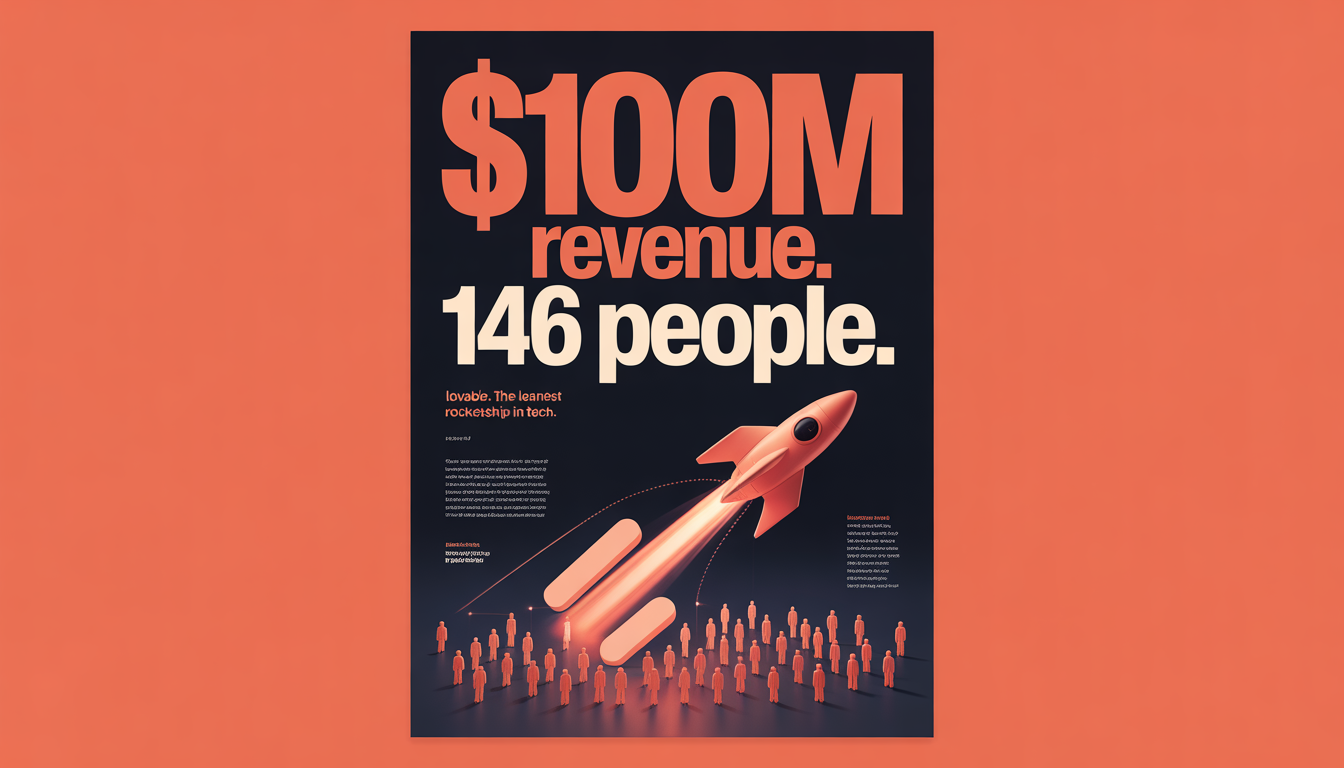
There are fast-growing companies. Then there is Lovable. The Stockholm-based AI startup confirmed this week that it crossed $400 million in annual recurring revenue (ARR) in February — after adding $100 million in a single month. That staggering leap was achieved not with an army of salespeople, engineers, or executives, but with a team of 146 people.
The figures, confirmed to TechCrunch, represent a revenue-per-employee ratio that defies almost every benchmark in the software industry. At $400 million ARR shared among 146 people, Lovable is generating approximately $2.7 million in revenue per employee — more than thirteen times the $200,000 benchmark that most high-performing SaaS companies celebrate reaching.
For context: it took Lovable just eight months to go from zero to $100 million ARR after its public launch in late 2024. It then doubled to $200 million by November 2025. By January 2026, it hit $300 million. Now, barely six weeks later, it has added another $100 million — the fastest $100 million increment in its history, and possibly in the history of software.
The Tool That Turned Non-Coders Into Builders
Lovable is a “vibe coding” platform — a category of AI tools that allow anyone to describe an app or website in plain language and have the software generate fully functional, deployable code in return. Users don’t need to know how to program. They just need an idea and a browser.
The company was founded in Stockholm, Sweden, in 2023 by Anton Osika and Fabian Hedin. Osika, then CTO of AI startup Depict.ai, built the first version of what would become Lovable in a single weekend, emerging from the duo’s open-source project GPT Engineer — a GitHub repository that accumulated over 50,000 stars in weeks and became one of the fastest-growing open-source projects ever.
Today, more than 100,000 new projects are built on Lovable every single day. Enterprise clients include Klarna, HubSpot, Uber, and Zendesk. More than half of Fortune 500 companies have used the platform, according to co-founder and CEO Anton Osika, who made the claim at Web Summit last November. The company’s user base was approaching eight million by late 2025.
“We believe in hiring super high-agency people and very technically focused talent. Most of the team are former founders.”
— Anton Osika, Co-founder & CEO, Lovable
A Revenue Trajectory Unlike Any Other
Lovable’s ARR history reads like a chart someone drew to make a point:
July 2025: $100 million ARR — reached just eight months after launch
November 2025: $200 million ARR — doubled in four months
January 2026: $300 million ARR — $100M added in under two months
February 2026: $400 million ARR — another $100M in a single month
The company is not disclosing whether it is still targeting $1 billion ARR by the end of 2026, telling TechCrunch only that its focus remains on “helping builders scale their impact with our platform.” If current momentum holds, however, the target may not be ambitious enough.
The $6.6 Billion Company Built Without a Traditional Sales Team
In December 2025, Lovable raised $330 million in a Series B funding round led by CapitalG and Menlo Ventures at a $6.6 billion valuation. NVIDIA’s venture arm, Salesforce Ventures, Databricks Ventures, Khosla Ventures, and HubSpot Ventures were among the participants — a roster that reads as a who’s-who of enterprise AI investors.
Remarkably, the company built to that valuation without a conventional sales organization. Osika has spoken openly about the deliberate choice not to build a traditional sales team, relying instead on product-led growth — the idea that the product itself acquires and retains customers through its quality and utility.
The pricing strategy has also been unconventional. Subscriptions begin at $20 per month and scale to $100 per month for premium tiers, with usage-based fees layered on top. In June 2025, Osika made the counterintuitive decision to move all Team-tier users to a less expensive Pro tier — effectively giving up $1.5 million in ARR in a single day — as a deliberate investment in customer loyalty and long-term retention.
Stockholm, Not Silicon Valley
One of the more frequently cited aspects of Lovable’s story is what the company did not do: relocate to San Francisco. Osika has said early investors and advisors consistently pressured him to move the company to Silicon Valley, warning that a European base would limit the company’s potential.
“It was tempting, but I really resisted that,” Osika said at the Slush 2025 conference in Helsinki. “I can sit here now and say, ‘Look, guys, you can build a global AI company from this country.'” The company’s success has become a rallying point for the European tech ecosystem, demonstrating that a deeply technical, global AI company does not need to be headquartered in California to compete at the highest level.
The Road to $1 Billion — and the Competition Closing In
Lovable’s breakneck growth has not gone unnoticed by the largest players in AI. Both Anthropic and OpenAI now offer coding tools — Claude Code and Codex respectively — that operate in adjacent territory. Lovable is built on top of models from these very companies, which means its most powerful potential competitors are also its core infrastructure providers.
For now, Lovable occupies a distinct niche: it is a fully integrated vibe-coding platform, not merely an API or command-line tool. The experience of going from idea to deployed app in minutes, without touching a terminal, is a product category that neither Claude Code nor Codex currently replicates end-to-end.
To stay ahead, Lovable is investing the Series B capital in three areas: deeper third-party integrations with tools like Notion, Linear, and Jira; expanded enterprise features including security, compliance, and dedicated support; and the full-stack infrastructure builders need — databases, payment processing, and hosting — to take projects from prototype to production.
The company has also launched its first major brand campaign, “Earworm,” running across YouTube, social platforms, and connected TV — a signal that Lovable is making the transition from developer-culture darling to mainstream consumer product.
Whether Lovable reaches $1 billion ARR by year-end remains to be seen. What is no longer in doubt is that it has permanently reframed what a small, highly motivated team can build — and how fast they can build it.
Lovable’s $400M ARR figure was confirmed to TechCrunch on March 11, 2026. The company’s $330M Series B was raised in December 2025 at a $6.6 billion valuation.