FUTURE OF WORK | ENTERPRISE AI | STRATEGY
How Agentic AI Will Change Businesses
The era of AI as a helpful assistant is ending. What comes next — autonomous agents that plan, decide, and act across entire business functions — will be as disruptive to the enterprise as the internet. The companies that understand the shift early will define the next decade. Those that don’t will be left managing the consequences.
By Searchmytool.com | March 15, 2026
For the past three years, most businesses have experienced artificial intelligence as a productivity upgrade. They gave employees access to a chatbot, watched them draft emails faster and summarize documents in seconds, and called it transformation. It was not transformation. It was a preview.
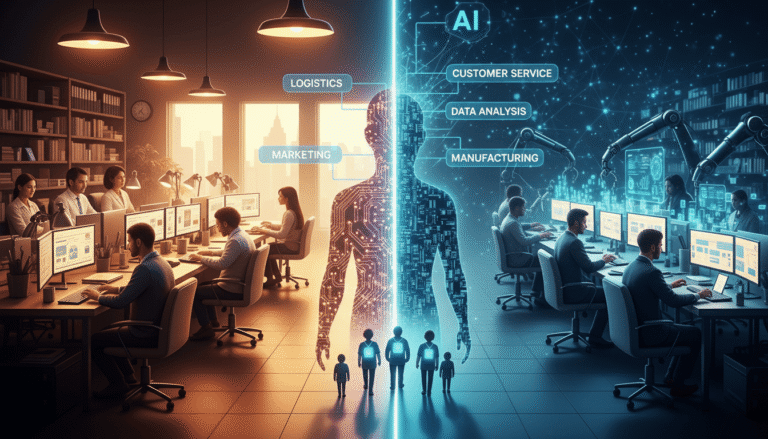
The real shift — the one that will reshape organizational structures, redefine competitive advantage, and permanently alter what it means to run a business — is only now arriving. It goes by the name agentic AI: artificial intelligence systems that do not merely respond to questions, but set goals, make decisions, use tools, collaborate with other AI systems, and carry out complex multi-step tasks across an organization, largely without human supervision.
The numbers signal how rapidly this shift is accelerating.
Gartner predicts that by end of 2026, 40% of enterprise applications will embed AI agents — up from fewer than 5% in 2025. IDC forecasts that 40% of all G2000 job roles will involve collaboration with AI agents within the same timeframe. The agentic AI market, currently valued at $7.8 billion, is projected to exceed $52 billion by 2030. And Jensen Huang, Nvidia’s CEO, has called enterprise AI agents a “multi-trillion-dollar opportunity” for industries ranging from healthcare to software engineering.
This is not a distant future scenario. It is the operational reality that leading enterprises are building toward right now. The question for every business leader is no longer whether agentic AI will reshape their organization — it is how prepared they are for when it does.
From Copilot to Colleague: What ‘Agentic’ Actually Means
The term “agentic” is used loosely enough to cause confusion, so a precise definition matters. A traditional generative AI tool — ChatGPT, Copilot, Claude in chat mode — operates reactively. You give it a prompt; it gives you an output. The interaction ends there. The tool has no memory of what happened before, no ability to take external actions, and no capacity to pursue a goal across multiple steps.
An agentic AI system operates differently in almost every dimension. MIT Sloan researchers define AI agents as “autonomous software systems that perceive, reason, and act in digital environments to achieve goals on behalf of human principals, with capabilities for tool use, economic transactions, and strategic interaction.” They can execute multi-step plans, use external tools, interact with digital environments, and function as powerful components within larger workflows.
Practically, this means an agentic AI can be assigned a complex goal — “analyze last quarter’s customer churn data, identify the top three contributing factors, draft a remediation plan, and schedule a review meeting with the relevant team leads” — and carry it through from beginning to end, navigating databases, writing reports, sending calendar invites, and flagging exceptions without being prompted at each step.
The leap from tool to agent is the leap from augmenting human labor to partially replacing it — and it fundamentally changes the economics of what businesses can do.
Six Business Functions Being Rewritten
Agentic AI is not a horizontal technology in the way that cloud computing was. Its impact is concentrated in the areas where human cognitive labor — analysis, communication, coordination, decision-making — drives the most value. Below are the six business functions where the change will be deepest.
1. Software Development
Software development is the first industry being transformed end-to-end by agents rather than merely assisted by them. GitHub’s agent mode and Azure-integrated Copilot flows have made “assign a task to the AI, get a pull request back” a standard workflow at companies including Microsoft, Google, and thousands of mid-market engineering teams.
Agents can now plan and execute code changes, run test suites, draft documentation, and open pull requests for human review — compressing what once took a developer several hours into a task that runs in the background while the engineer focuses on architecture and strategy. The implication is not that engineers disappear; it is that a team of ten can now operate with the throughput of a team of fifty.
2. Customer Experience and Commerce
The standard chatbot — the script-following, FAQ-regurgitating assistant that has frustrated customers for a decade — is being replaced by something categorically different. Agentic customer experience systems can access order histories, process returns, negotiate resolutions, escalate intelligently, and close the loop without a human agent, at any hour.
In commerce, the transformation is even more profound. Google has built a shopping agent capable of creating a shopping list from a handwritten recipe and automatically purchasing the items. During the 2025 holiday season, AI was credited with driving 20% of all retail sales globally, generating $262 billion in revenue through personalized recommendations and improved engagement. AI-driven search conversations are now two to three times longer and more detailed than traditional keyword searches — suggesting that consumers are shifting from clicking to delegating.
3. Finance, Compliance, and Legal
Finance functions that currently require armies of analysts — reconciliation, variance analysis, regulatory reporting, contract review — are prime targets for agentic automation. Agents can be granted read access to financial systems, instructed to flag anomalies against policy, draft board-ready summaries, and route exceptions to human reviewers, all within a governed, auditable framework.
Legal and compliance teams are seeing similar dynamics. Contract analysis that once required a paralegal’s full day can be completed in minutes. Regulatory change monitoring — tracking legislative databases across dozens of jurisdictions and flagging relevant updates — is a task AI agents perform continuously and without fatigue.
4. Marketing and Sales
The combination of deep personalization and autonomous execution is turning marketing and sales into the domain where agentic AI may deliver the most immediate and measurable return on investment. Agent systems can monitor prospect behavior across channels, personalize outreach at a scale no human team could match, qualify leads, schedule meetings, and update CRM systems — all in real time.
For brands, the rise of AI shopping agents on the consumer side introduces an entirely new imperative: “answer engine optimization” (AEO). Brands that previously obsessed over search engine rankings must now ensure their products are legible to AI agents that shop on behalf of customers — a shift that requires rethinking product data architecture, description formatting, and structured data standards.
5. Operations and Supply Chain
Supply chain management, characterized by enormous data complexity, tight feedback loops, and the constant need to balance competing constraints, is a natural fit for agentic systems. Agents can monitor inventory levels, model demand scenarios, negotiate with suppliers, and trigger reorder workflows — tasks that today require coordination across multiple human specialists and systems.
Walmart — the world’s largest retailer — has stated publicly that it is “not just watching the shift, but driving it,” investing aggressively in agentic systems that span its entire operational stack. When the world’s most operationally sophisticated retailer declares agentic AI central to its competitive strategy, every company in its supply chain has reason to pay attention.
6. Human Resources and Talent Management
Microsoft rolled out role-based agents inside Microsoft 365 that can handle scheduling, onboarding workflows, policy lookups, and benefits queries — and then hand off results to human HR professionals. These are not novelties. They represent a fundamental shift in how HR capacity gets allocated, allowing people teams to spend less time on process administration and more time on the human judgment calls that require it.
“The agentic AI age is already here. We have agents deployed at scale in the economy to perform all kinds of tasks.”
— Sinan Aral, Professor of Management, IT, and Marketing, MIT Sloan
The Efficiency Dividend — and the Revenue Opportunity
The conventional framing of AI’s business value centers on cost reduction and efficiency gains. This framing is accurate but incomplete — and increasingly, it is the second-order effects that executives are prioritizing.
IDC’s FutureScape 2026 research found that 70% of G2000 CEOs plan to focus AI ROI on growth — new revenue streams, new market entry, new product development — rather than cost savings. This is a significant philosophical shift. Efficiency gains from AI are real and meaningful; most organizations report double-digit productivity improvements in the functions where agents have been properly deployed. But the larger prize is using the capacity freed by automation to pursue opportunities that were previously out of reach.
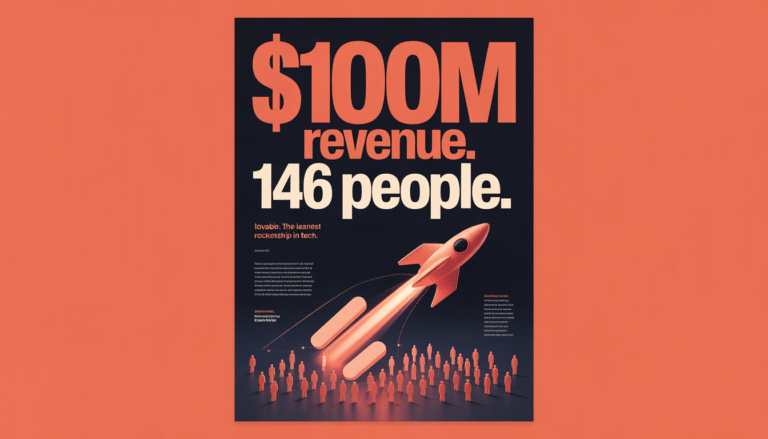
Lovable, the Stockholm-based AI platform, is perhaps the most dramatic current illustration of this principle. With just 146 employees, the company generates approximately $2.7 million in annual recurring revenue per person — a ratio that would have been considered impossible in enterprise software three years ago. The company’s CEO, Anton Osika, attributes much of this efficiency not to austerity but to agentic AI systems embedded across every business function, from engineering to customer support.
The Lovable case is extreme, but directionally instructive. Agentic AI does not merely make existing organizations more efficient. It changes the relationship between headcount and output — and in doing so, it reshapes what competitive scale actually means.
The Gap Between Promise and Production
For all the optimism around agentic AI, the gap between aspiration and operational reality remains wide. McKinsey research finds that while 62% of organizations are experimenting with AI agents, only 23% have begun scaling them in any function. Gartner, notably, predicts that over 40% of agentic AI projects will be canceled before they reach production.
The reasons are instructive. According to Deloitte’s research, the most common failure mode is not a limitation of the AI itself — it is a limitation of the data and processes around it. Nearly half of organizations in a 2025 Deloitte survey cited searchability of data and reusability of data as challenges blocking their AI automation strategy. Enterprise data architectures built around traditional data warehouses create friction for agents that need real-time contextual information to make good decisions.
The second common failure mode is strategic: organizations that treat agents as productivity add-ons — layering them on top of existing processes — consistently fail to scale. The organizations that succeed are those that redesign their workflows with agents in mind from the beginning. As McKinsey puts it, the key differentiator is “the willingness to redesign workflows rather than simply layering agents onto legacy processes.”
The third challenge is governance. Agentic systems that act — that send emails, execute transactions, update databases, and interact with customers — expand the potential consequences of error. Prompt injection attacks, data exfiltration risks, and tool misuse are all amplified when the AI is not just answering a question but taking an action. Leading organizations in 2026 are making governance — audit trails, human-in-the-loop checkpoints, graduated authorization frameworks — a foundational requirement, not an afterthought.
The Workforce Question
No article on agentic AI and business can sidestep the workforce question, because it is the one that employees, unions, policymakers, and executives are all asking simultaneously: what happens to human jobs?
The honest answer is that the picture is more complex than either the utopian or dystopian framing suggests. IDC’s prediction — that 40% of G2000 job roles will involve collaboration with AI agents by 2026 — is a collaboration forecast, not a displacement forecast. MIT Sloan research has found that when humans work alongside AI agents, such pairings can lead to improved productivity and performance. The most capable workers, in most studied cases, benefit most from the pairing.
What is less ambiguous is that the nature of many roles will change substantially. Tasks that were once the primary activity of an analyst, paralegal, customer service representative, or junior developer will increasingly be handled by agents. The human role shifts toward oversight, judgment, exception handling, and the work that benefits from empathy, creativity, and contextual understanding — things AI agents do poorly.
This transition is not painless or automatic. It requires investment in re-skilling, thoughtful change management, and organizational structures that help people work alongside intelligent systems rather than in competition with them. The companies that handle this transition well will retain the institutional knowledge and human judgment that no agent can replicate. The companies that handle it poorly will face the double cost of failed AI implementations and disengaged workforces.
The Protocols That Will Define the Infrastructure
Beneath the business strategy layer, a technical infrastructure race is underway that will determine which organizations can scale agentic AI effectively and which will remain trapped in pilot purgatory.
Anthropic’s Model Context Protocol (MCP) and Google’s Agent-to-Agent (A2A) Protocol are establishing the interoperability standards for the agentic web. MCP standardizes how agents connect to external tools, databases, and APIs — transforming what was previously custom integration work into a plug-and-play architecture. A2A goes further, defining how agents from different vendors and platforms communicate with one another, enabling multi-agent workflows that cross organizational boundaries.
The analogy that practitioners use most frequently is instructive: MCP and A2A are to agentic AI what HTTP was to the web. Just as HTTP enabled any browser to access any server regardless of who built it, these protocols enable any agent to use any tool or collaborate with any other agent. The organizations that understand this infrastructure layer will build composable, future-proof systems. Those that build proprietary, siloed agent implementations will pay a large integration tax later.
What Leaders Should Do Now
Given the pace of change, the right framework for business leaders is not “when should we start” — most organizations are already behind. The more useful question is: what sequence of decisions will give us the best chance of scaling effectively?
Start with governance, not ambition. The organizations that have scaled agentic AI successfully in 2025 did not start with the most ambitious use cases. They started by establishing the frameworks — access controls, audit trails, human escalation paths, compliance guardrails — that make it safe to give AI agents consequential tasks. Governance is not a constraint on progress; it is the prerequisite for it.
Fix the data foundation first. Agents are only as good as the data they can access and understand. Organizations with fragmented, poorly indexed data will find that agents either make poor decisions or require constant human correction. The investment in making enterprise data searchable, contextually rich, and agent-consumable is not a downstream consideration — it is the foundation on which every agentic capability is built.
Redesign processes, don’t just automate them. The most common and costly mistake in agentic AI deployment is taking an inefficient human process and automating it. The result is a faster version of a bad process. The highest-ROI implementations involve stepping back to ask what the process would look like if it were designed from scratch for a world where AI agents handled the cognitive labor.
Invest in change management alongside technology. The technical implementation of agentic AI is frequently the easier half of the challenge. Helping people understand how their roles are changing, equipping them with skills to work effectively alongside agents, and creating cultures of experimentation and trust are the harder — and ultimately more decisive — factors in whether AI transformation succeeds or stalls.
Think in ecosystems, not just internal deployments. The emergence of MCP and A2A protocols means that agentic AI will increasingly operate across organizational boundaries — between companies, suppliers, customers, and partners. Organizations that build for this interconnected future, structuring their agent systems to interoperate with external agents, will have structural advantages over those building walled gardens.
The Defining Technology of This Business Decade
There have been three inflection points in the modern history of business technology: the mainframe, which centralized information processing; the internet, which connected everything; and the smartphone, which made computing ambient. Each one seemed incremental in its early stages and transformational in retrospect.
Agentic AI is the fourth. Its early stages — the chatbots, the copilots, the pilot programs of 2023 and 2024 — looked incremental. What is becoming clear in 2026 is that the underlying shift is structural: artificial intelligence systems are moving from augmenting human decision-making to partially replacing it, at scale, across every business function.
The businesses that will be best positioned in five years are not necessarily those with the largest AI budgets or the most aggressive deployment timelines. They are the ones that treat this moment with the seriousness it deserves — investing in the foundations, managing the transition thoughtfully, and building for a world where human judgment and artificial intelligence are genuinely complementary rather than in competition.
The question every leader should be sitting with is not “are we using AI?” Almost everyone is. The question is: “Are we building an organization designed for the agentic era?” The answer to that question will separate the leaders from the laggards by the end of this decade.