Something happened in early February 2026 that stopped the tech world in its tracks.
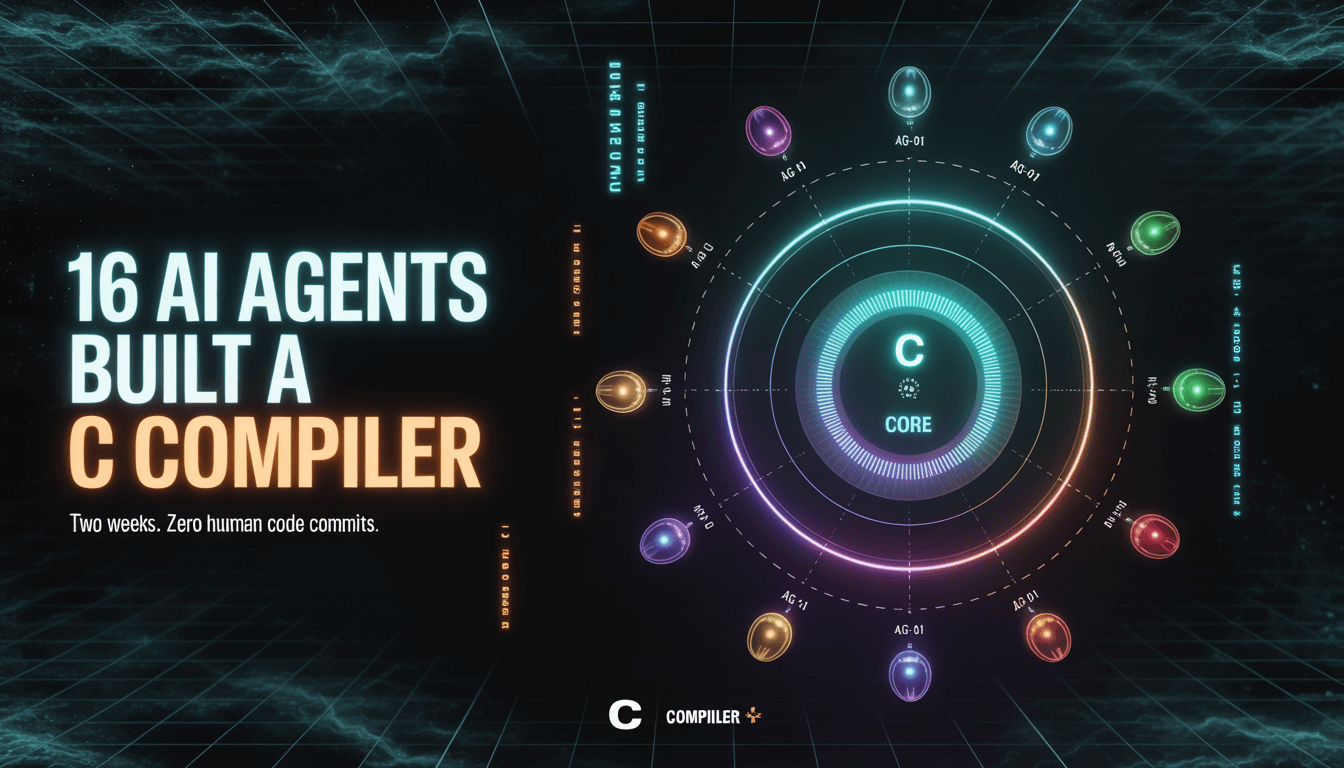
A single researcher at Anthropic. Sixteen AI agents. No human supervision. Two weeks.
The result? A working C compiler. 100,000 lines of code. Built almost entirely by machines.
The internet exploded. “AI is replacing programmers.” “GCC took 37 years. AI did it in 14 days.” Headlines went everywhere.
But here’s the thing. The real story is more nuanced than the headlines. And honestly? More interesting too.
Let’s break down exactly what happened, what it means, and what it doesn’t mean.
Who Did This and Why?
Nicholas Carlini, a researcher on Anthropic’s Safeguards team, set up 16 instances of Claude Opus 4.6 with a new approach called “agent teams” — multiple Claude instances working in parallel on a shared codebase without active human intervention.
Carlini isn’t just any researcher. He spent seven years at Google Brain and DeepMind before joining Anthropic. The guy knows AI deeply.
His goal wasn’t to replace human programmers. It was to test something specific. How far can autonomous AI agents go on a genuinely hard, long-horizon engineering task?
So he picked one of the hardest tasks in computing. Building a C compiler from scratch.
What Is a C Compiler, and Why Does It Matter?
Quick background for non-developers.
A compiler is a program that translates human-written code into machine instructions computers can run. Every piece of software you use — every app, every operating system — depends on compilers.
The C programming language is 53 years old. It powers Linux. It runs servers. It’s the foundation of modern computing.
Building a C compiler is not easy. It’s considered one of the most complex software engineering challenges. You need to handle parsing, code generation, optimization, multiple CPU architectures, and thousands of edge cases.
A C compiler is a near-ideal task for semi-autonomous AI coding: the specification is decades old and well-defined, comprehensive test suites already exist, and there’s a known-good reference compiler to check against.
That’s actually an important point. We’ll come back to it.
What Exactly Happened?
The compiler was developed over two weeks using 16 independent Claude Opus 4.6 agents. Each AI agent ran inside its own Docker container, cloned the same Git repository, and worked without a central controller or human manager. Tasks were picked automatically, conflicts were resolved through Git, and code was pushed upstream without supervision.
Read that again. No manager. No code reviews from humans. No pair programming.
Each agent woke up, looked at the shared codebase, picked the most obvious problem, fixed it, and pushed the changes. Then the next agent did the same.
The agents picked their own tasks, coordinated through git, resolved their own merge conflicts, and kept going — for nearly 2,000 sessions over two weeks.
Nearly 2,000 sessions. Continuous. Around the clock.
The Numbers Are Staggering
Let’s put the raw stats on the table.
Over nearly 2,000 Claude Code sessions and $20,000 in API costs, the agent team produced a 100,000-line compiler that can build Linux 6.9 on x86, ARM, and RISC-V.
Here’s what that $20,000 breaks down to:
- API costs: ~$17,400
- Cloud infrastructure for testing: ~$1,800
- Testing resources: ~$800
Opus 4.6 consumed 2 billion input tokens and generated 140 million output tokens.
Two billion tokens. In two weeks. The agents read and processed an enormous amount of information to get this done.
What Can This Compiler Actually Do?
The compiler is not a toy. Not a demo. Not a “Hello World” machine.
The compiler successfully handled large, complex codebases such as the Linux kernel and other widely used open-source projects. It also passed a significant portion of GCC’s torture test suite, which is a brutal collection of edge cases designed to break C compilers.
Here’s the full list of what it can compile:
- Linux kernel 6.9 (on x86, ARM, and RISC-V)
- PostgreSQL
- Redis
- FFmpeg
- SQLite
- QEMU
- Doom
The project compiles the Linux kernel and passes 99% of GCC’s tests.
99%. On GCC’s torture test suite. That’s the standard professional compiler engineers use to stress-test their work.
And yes — it runs Doom. Because apparently that’s still the developer’s ultimate proof of concept.
How Did the Agents Coordinate?
This is the part that genuinely impressed engineers who read Carlini’s post.
Each agent claimed tasks by writing files to a current_tasks/ directory. When two agents attempted the same task, git’s synchronization forces the second agent to pick a different one. Agents would pull upstream changes, merge modifications from peers, push their work, and release locks — essentially mimicking how human developers collaborate on large projects.
Simple. Elegant. Brilliant.
No complex orchestration system. No central controller. Just Git as the coordination layer.
The agents used the same tools human developers use every day. And it worked.
Some specialized agents handled duplicate code. Another focused on performance. A few critiqued design like a Rust expert would. Others updated documentation.
Specialization emerged naturally. No one told them to divide labor that way.
The Clever Problem-Solving Moment
Halfway through the project, the agents hit a wall.
When agents started to compile the Linux kernel, they got stuck. Unlike a test suite with hundreds of independent tests, compiling the Linux kernel is one giant task. Every agent would hit the same bug, fix that bug, and then overwrite each other’s changes.
All 16 agents. Same bug. Same fix. Overwriting each other. Going in circles.
Carlini stepped in. He designed a clever workaround.
He used GCC as an “oracle,” compiling most kernel files with GCC and only a random subset with Claude’s compiler. If the kernel broke, the bug was in Claude’s subset. This turned one monolithic problem into many smaller, parallelizable ones. Each agent could now chase a different bug.
One human intervention. One smart design decision. And 16 agents got back to work — each fixing different bugs simultaneously.
That’s the real story of human-AI collaboration in 2026. Not AI working alone. Not humans doing everything. A skilled person designing the environment for AI to succeed.
What Doesn’t Work: Carlini Was Honest
Here’s where many headlines got lazy. They ignored the limitations.
Carlini was completely upfront about what the compiler can’t do.
The compiled code is not very efficient. Even with all optimizations enabled, it outputs less efficient code than GCC with all optimizations disabled. The Rust code quality is “reasonable” but nowhere near the quality of what an expert Rust programmer might produce.
That’s a significant gap. GCC with no optimizations beats Claude’s compiler at its best.
It lacks the 16-bit x86 compiler that is necessary to boot Linux out of real mode. Claude simply cheats here and calls out to GCC for this phase.
Cheats. Carlini’s own word. For the most important piece of the x86 bootloader, the compiler delegates to the very tool it was meant to replace.
Toward the end of the project, fixing bugs and adding features “frequently broke existing functionality.” The model hit this wall at around 100,000 lines, which suggests a practical ceiling for autonomous agentic coding, at least with current models.
100,000 lines seems to be the current limit. Beyond that, things fall apart.
The Internet Had Thoughts
When the GitHub repository went public, developers were not quiet.
One commenter put it memorably. “If I went to the supermarket, stole a bit of every bread they had, and shoved it together, no one would say I made bread from scratch. They’d say I’m a thief. If this is ‘from scratch,’ then my cooking is farm-to-table.”
The “from scratch” claim bothered many. Saying it didn’t access the internet is like a student saying: “I had copies of the code I was working on, but I’d turned my Wi-Fi off.”
The AI was trained on massive amounts of open-source code. Including GCC. Including Clang. Including dozens of smaller C compilers.
The AI’s achievement is, in a very real sense, built on the shoulders of the very human engineers it is being compared to.
That’s a fair point. And an honest one.
But here’s the counterargument. Every human compiler engineer learned from reading existing code too. The question isn’t whether you learned from others. The question is whether you can apply that knowledge to build something real.
And the agents did.
The GCC Comparison: Is It Fair?
The headline “GCC took 37 years, AI did it in 2 weeks” spread everywhere.
GCC’s evolution tracks the evolution of computing itself — new processor architectures, new C and C++ language standards, sophisticated optimization passes that can mean the difference between software running in milliseconds versus seconds, and debugging capabilities that millions of developers rely on daily.
GCC doesn’t just compile C. It compiles C, C++, Fortran, Ada, Go, and more. It supports dozens of architectures. It has been hardened over decades of real-world usage at massive scale.
The Anthropic compiler supports C. On three architectures. With known efficiency gaps.
Comparing them directly is like saying a new sedan “did what it took Boeing 50 years to do” because they both carry people from one place to another.
Technically true in a narrow sense. Completely misleading in every practical sense.
What The Researcher Himself Feels About It
This is the most honest part of the whole story.
Carlini wrote: “So, while this experiment excites me, it also leaves me feeling uneasy. Building this compiler has been some of the most fun I’ve had recently, but I did not expect this to be anywhere near possible so early in 2026.”
Uneasy. That’s his word.
As a former pen-tester, he said fully autonomous development posed real risks. “The thought of programmers deploying software they’ve never personally verified is a real concern.”
Think about that. The person who ran this experiment is worried about what it means.
Not because AI is dangerous in some abstract sense. But because we’re building systems faster than our ability to understand and verify them.
He knows what happens when software has hidden bugs. He spent his career finding them. And now he’s watching AI generate 100,000 lines of code that no human has fully read.
That’s a real problem. One worth taking seriously.
What This Actually Proves
Strip away the hype. Strip away the backlash. Here’s what actually happened.
1. AI agents can handle genuinely complex, long-horizon engineering work.
Not just autocomplete. Not just finishing functions. A full 100,000-line software project. Two weeks. Minimal supervision.
That’s new. That matters.
2. The coordination mechanism works.
Getting multiple AI agents to collaborate without fighting or duplicating work is a real engineering challenge. The Git-based approach was clean and effective. Other developers can learn from this.
3. The human role shifted, not disappeared.
The human role didn’t disappear. It shifted from writing code to engineering the environment that lets AI write code. The researcher functioned more like an architect and systems engineer than a traditional programmer.
That’s the actual future of software development. Humans designing systems. Setting up tests. Creating feedback loops. Stepping in when agents hit ceilings.
4. Current models have clear limits.
It’s much closer to an “interesting lab demo” than an “obituary for human programmers.”
That feels right. Impressive demo. Real limits. Exciting direction.
5. Claude Opus 4.6 is a genuine leap.
The jump to Opus 4.6 is not incremental — it’s categorical. Previous Opus versions could barely produce a functional compiler at all.
What was impossible recently is possible now. That curve is steep.
What This Means for Software Developers
Should developers be worried? Let’s be direct.
Not yet. But paying attention matters.
AI simply isn’t ready to take over programming jobs yet, no matter how many CEOs insist it’s already a game-changer. No, it’s just a useful tool that requires careful, expert use to be effective.
The skills changing in value right now are specific. Writing boilerplate code? AI does that better. Understanding systems? Designing architectures? Knowing what to test and why? Still deeply human.
The developers thriving in 2026 are the ones who understand what AI can and can’t do. Who design good test harnesses. Who know when to trust AI output and when to audit it carefully.
Test engineering becomes more valuable than implementation code. Infrastructure skills matter more. Building environments that enable AI productivity — CI/CD, monitoring, rollback systems — that’s where human value concentrates.
Architectural thinking. Oversight. Judgment. These grow in value as AI handles more execution.
The Broader Picture
Today, it’s a C compiler. Tomorrow, it could be entire backend systems, distributed infrastructure, simulation engines, or domain-specific languages.
That’s the real takeaway.
Not that AI replaced compiler engineers. That AI demonstrated it can manage complex, long-running software projects with genuine autonomy.
The ceiling moved. Significantly.
The economics of software development are about to change dramatically. At $20K for what would traditionally be a multi-million dollar project, the cost dynamics shift fundamentally.
$20,000. Two weeks. Tasks that previously required large teams and years.
Even if the output needs refinement, the starting point changes everything.
The Key Lesson From Carlini’s Experiment
Carlini shared several hard-won lessons for anyone building with AI agent teams.
Write extremely high-quality tests. Bad tests let agents chase the wrong goals forever.
Put yourself in the agent’s shoes. Don’t flood output with thousands of irrelevant bytes. Make it easy for agents to find what matters.
Watch for time-blindness. “Claude can’t tell time and, left alone, will happily spend hours running tests instead of making progress.” Build in progress checks.
Design for parallelism from the start. One monolithic task kills momentum. Break work into independent pieces agents can claim and complete without stepping on each other.
Know when to intervene. When all agents get stuck on the same problem? That’s when a human needs to redesign the task structure.
These are practical engineering lessons. Applicable right now.
The Bottom Line
Here’s the honest summary.
Anthropic’s 16 AI agents built a real, working C compiler in two weeks for $20,000. It compiles Linux. It passes 99% of GCC’s stress tests. It runs Doom.
It’s also slower than GCC. Less efficient. Partly dependent on GCC for certain features. Built on training data from decades of human engineering work. And it hits a wall at 100,000 lines.
Both things are true.
This is a remarkable proof of concept. Not a replacement for human developers. Not a one-to-one comparison with GCC. Not evidence that AI invents anything new.
But it is strong evidence that AI can execute complex, long-horizon engineering projects autonomously. That multi-agent coordination works at scale. That the role of human engineers is changing — from writing every line to designing systems where AI writes many of the lines.
That’s when things started to change. A team of AI agents, with no internet access, no human supervision, wrote a working C compiler in Rust that can build the Linux kernel. For $20,000. In two weeks.
Carlini said he didn’t expect this to be possible so early in 2026.
That should tell you everything about how fast things are moving.
Key Facts at a Glance
- Who: Nicholas Carlini, Anthropic Safeguards team researcher
- What: 16 Claude Opus 4.6 agents building a Rust-based C compiler
- Time: Two weeks (published February 5, 2026)
- Cost: ~$20,000 in API costs
- Code: ~100,000 lines of Rust
- Sessions: Nearly 2,000 Claude Code sessions
- Tokens: 2 billion input, 140 million output
- What it compiles: Linux 6.9 (x86, ARM, RISC-V), PostgreSQL, Redis, FFmpeg, SQLite, QEMU, Doom
- Test score: 99% pass rate on GCC torture test suite
- Limitations: Slower than GCC, less efficient code output, no assembler/linker, can’t handle 16-bit x86 bootloader independently
- Source code: Open-source, available on GitHub